


Page 10 - Process_book_Carla Ann_Lloren
P. 10
2

                                                                                                                                           Chapter 2 Explore


                                                                                                                                                   Literature Review


            Why is there a need to relook at social Isolation/loneliness                                         There is a wide range of current popular solutions

                              amongst older adults in Ireland?                                                 to address social isolation/loneliness amongst older
                                                                                                                 adults but issue is still prevalent in the country …


                                  The recent study released in 2023 by the European
                                  Commission’s Joint Research Center (JRC) showed loneliness
                                  is most prevalent in Ireland relative to other European
                                  countries. The country leads in share of respondents feeling
                                  lonely with over 20% of participants “reported feeling lonely
                                  most or all of the time.” (Joint Research Center, 2023).


                                  Specific to older adults 65 years old and up, Alone’s Q1 of 2023
                                  report supported that a lot of older adults newly getting in
                                  touch with them have been experiencing social isolation. This is
                                  likewise reflected in their figures where ... “36 percent of these
                                  individuals had not engaged in social activities for more than a                                                                                                      EXPLORE
                                  month and a concerning nine per cent had not participated in
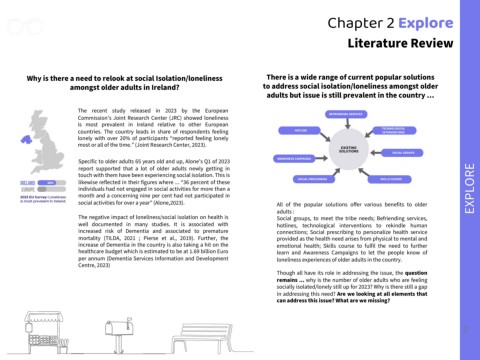
                                  social activities for over a year” (Alone,2023).                                   All  of  the  popular  solutions  offer  various  benefits  to  older
                                                                                                                     adults :
                                  The negative impact of loneliness/social isolation on health is                    Social  groups,  to  meet  the  tribe  needs;  Befriending  services,
                                  well documented in many studies. It is associated with                             hotlines,  technological  interventions  to  rekindle  human
                                  increased risk of Dementia and associated to premature                             connections;  Social  prescribing  to  personalize  health  service
                                  mortality (TILDA, 2021 ; Pierse et al., 2019). Further, the                        provided as the health need arises from physical to mental and
                                  increase of Dementia in the country is also taking a hit on the                    emotional  health;  Skills  course  to  fulfil  the  need  to  further
                                  healthcare budget which is estimated to be at 1.69 billion Euro                    learn  and  Awareness  Campaigns  to  let  the  people  know  of
                                  per annum (Dementia Services Information and Development                           loneliness experiences of older adults in the country.
                                  Centre, 2023)
                                                                                                                     Though all have its role in addressing the issue, the question
                                                                                                                     remains ... why is the number of older adults who are feeling
                                                                                                                     socially isolated/lonely still up for 2023? Why is there still a gap
                                                                                                                     in addressing this need? Are we looking at all elements that
                                                                                                                     can address this issue? What are we missing?


                                                                                                                                                                                                    5

