


Page 5 - Doc1
P. 5
CHAPTER I

                                                       TENSES

               A.  Definition of Tenses
                          In  learning  English  grammar,  tenses  play  a  fundamental  role  in  expressing  the
                   time and nature of an action or event. Understanding tenses is essential for constructing
                   grammatically correct sentences and for communicating ideas clearly in both spoken and
                   written English. Through the use of tenses, speakers and writers are able to indicate when
                   an action happens, whether in the past, present, or future, and to describe the continuity,
                   completion, or repetition of that action.
                          Tenses in English indicate the time and aspect of an action, event, or state. They
                   show when something happens (time) and how it happens (aspect). There are twelve main
                   tenses in English, divided into three primary time frames: Present, Past, and Future, each
                   with five aspects: Simple, Continuous (Progressive), Perfect, Perfect Continuous, and
                   Past Perfect Progressive.
                          However, many learners find tenses  challenging due to differences between the
                   grammatical systems of English and their native language. Therefore, this section aims to
                   provide  a  clear  and  systematic  explanation  of  each  tense,  supported  by  examples  and
                   contextual exercises to strengthen understanding and practical application.
                          By the end of this topic, students are expected to be able to:
                   1.  Identify and explain the function of each English tense.
                   2.  Use the appropriate tense in various communicative contexts.
                   3.  Recognize time expressions that commonly accompany each tense.
                   4.  Apply tenses correctly in academic writing and everyday conversation.
                          In summary, tenses are not merely grammatical rules to memorize, but essential
                   tools  for  expressing  time,  meaning,  and  intention  precisely  in  communication. A  solid
                   understanding of tenses serves as the foundation for mastering more advanced grammar
                   topics and developing overall language proficiency.
               B.  Overview of Tenses
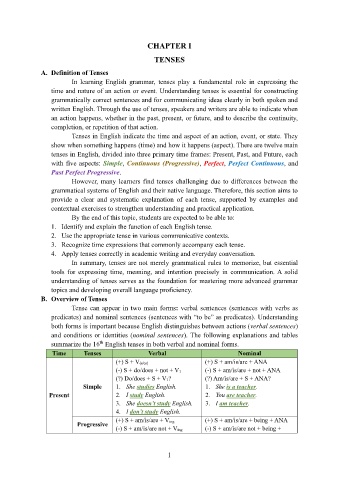
                          Tense can appear in two main forms: verbal sentences (sentences with verbs as
                   predicates) and nominal sentences (sentences with “to be” as predicates). Understanding
                   both forms is important because English distinguishes between actions (verbal sentences)
                   and conditions or identities (nominal sentences). The following explanations and tables
                                    th
                   summarize the 16  English tenses in both verbal and nominal forms.
                   Time       Tenses                 Verbal                          Nominal
                                          (+) S + V(s/es)                (+) S + am/is/are + ANA
                                          (-) S + do/does + not + V1     (-) S + am/is/are + not + ANA
                                          (?) Do/does + S + V1?          (?) Am/is/are + S + ANA?
                              Simple      1.  She studies English.       1.  She is a teacher.
                  Present                 2.  I study English.           2.  You are teacher.
                                          3.  She doesn’t study English.   3.  I am teacher.
                                          4.  I don’t study English.
                                          (+) S + am/is/are + Ving       (+) S + am/is/are + being + ANA
                            Progressive
                                          (-) S + am/is/are not + Ving   (-) S + am/is/are not + being +


                                                            1

