


Page 10 - Doc1
P. 10
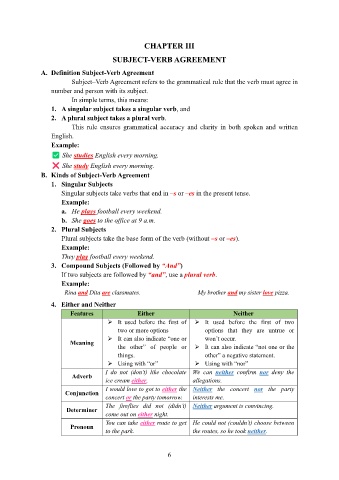
CHAPTER III

                                         SUBJECT-VERB AGREEMENT

               A.  Definition Subject-Verb Agreement
                          Subject–Verb Agreement refers to the grammatical rule that the verb must agree in
                   number and person with its subject.
                          In simple terms, this means:
                   1.  A singular subject takes a singular verb, and
                   2.  A plural subject takes a plural verb.
                          This  rule  ensures  grammatical  accuracy  and  clarity  in  both  spoken  and  written
                   English.
                   Example:
                     She studies English every morning.

                     She study English every morning.
               B.  Kinds of Subject-Verb Agreement
                   1.  Singular Subjects
                       Singular subjects take verbs that end in –s or –es in the present tense.
                       Example:
                       a.  He plays football every weekend.
                       b.  She goes to the office at 9 a.m.
                   2.  Plural Subjects
                       Plural subjects take the base form of the verb (without –s or –es).
                       Example:
                       They play football every weekend.
                   3.  Compound Subjects (Followed by “And”)
                       If two subjects are followed by “and”, use a plural verb.
                       Example:
                        Rina and Dita are classmates.                 My brother and my sister love pizza.

                   4.  Either and Neither
                          Features               Either                            Neither
                                       ➢  It  used  before  the  first  of   ➢  It  used  before  the  first  of  two
                                          two or more options            options  that  they  are  untrue  or
                                       ➢  It can also indicate “one or   won’t occur.
                          Meaning
                                          the  other”  of  people  or   ➢  It can also indicate “not one or the
                                          things.                        other” a negative statement.
                                       ➢  Using with “or”            ➢  Using with “nor”
                                      I  do  not  (don’t)  like  chocolate  We  can  neither  confirm  nor  deny  the
                          Adverb
                                      ice cream either.              allegations.
                                      I would love to got to either the  Neither  the  concert  nor  the  party
                        Conjunction
                                      concert or the party tomorrow.   interests me.
                                      The  fireflies  did  not  (didn’t)  Neither argument is convincing.
                        Determiner
                                      come out on either night.
                                      You can take either route to get  He could not (couldn’t) choose between
                          Pronoun
                                      to the park.                   the routes, so he took neither.


                                                            6

