


Page 13 - Doc1
P. 13
with the, a, an, or one.        ➢  Require  words  like  “piece”,
                                      ➢  Plural noun can be prefixed with    “glass”,  or  “bag”  to  be
                                         two,  three,  etc,  and  add  “s”  or   measured  (e.g.,  a  piece  of
                                         “es” the end word.                  furniture, a glass of water).
                                      ➢  Article  “an”  only  for  vocal
                                         sounds (A, I, U, E, O).
                                      ➢  Article  “a”  only  for  consonant
                                         sounds.
                                      ➢  I have a brother and two sisters.   ➢  Watermelon  contains  a  lot  of
                                      ➢  Ryan  has  a  cheese  sandwich      water.
                           Example
                                         and an apple for breakfast.     ➢  They  taking  huge  amounts  of
                                                                             our money.

                       e.  Compound Noun
                                  A compound noun is a noun that consists of two or more nouns that have
                          a different meaning than if each noun stood alone, such as: post office, airport,
                          boyfriend, breakfast, etc.
                       f.  Possessive Noun
                          Possessive  nouns  are  words  used  to  indicate  ownership  of  an  object,  such  as:
                          Ferdy’s house, Swiss’ capital city, lecture’s book, etc.
                   2.  Pronoun
                       A pronoun replaces a noun to avoid repetition. Types of Pronouns:
                       a.  Personal Pronouns
                          ➢  Used to replace specific nouns for people or things.
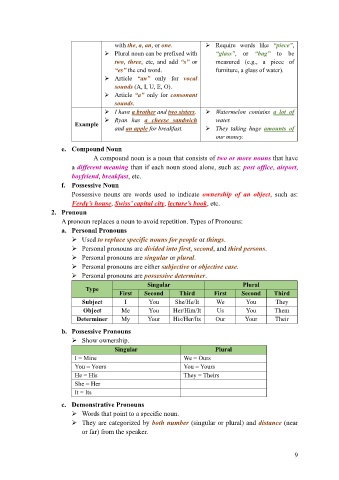
                          ➢  Personal pronouns are divided into first, second, and third persons.
                          ➢  Personal pronouns are singular or plural.
                          ➢  Personal pronouns are either subjective or objective case.
                          ➢  Personal pronouns are possessive determiner.
                                                     Singular                         Plural
                               Type
                                           First    Second      Third       First     Second     Third
                              Subject        I       You       She/He/It     We        You        They
                              Object        Me       You      Her/Him/It     Us        You       Them
                            Determiner      My       Your     His/Her/Its    Our       Your       Their

                       b.  Possessive Pronouns
                          ➢  Show ownership.
                                         Singular                            Plural
                           I = Mine                               We = Ours
                           You = Yours                            You = Yours
                           He = His                               They = Theirs
                           She = Her
                           It = Its

                       c.  Demonstrative Pronouns
                          ➢  Words that point to a specific noun.
                          ➢  They are categorized by both number (singular or plural) and distance (near
                              or far) from the speaker.


                                                                                                        9

