


Page 16 - Doc1
P. 16
when you came to pick me up.        competition.

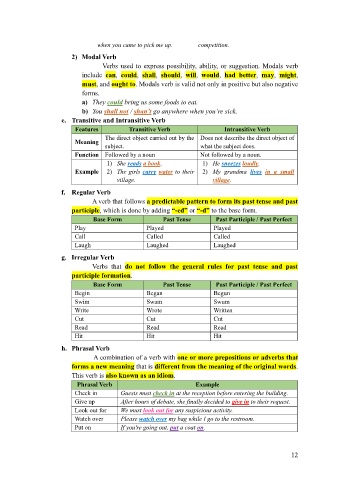
                          2)  Modal Verb
                                     Verbs used to express possibility, ability, or suggestion. Modals  verb
                              include  can,  could,  shall,  should,  will,  would,  had  better,  may,  might,
                              must, and ought to. Modals verb is valid not only in positive but also negative
                              forms.
                              a)  They could bring us some foods to eat.
                              b)  You shall not / shan’t go anywhere when you’re sick.
                       e.  Transitive and Intransitive Verb
                           Features           Transitive Verb                   Intransitive Verb
                                      The direct object carried out by the  Does not describe the direct object of
                           Meaning
                                      subject.                         what the subject does.
                           Function  Followed by a noun                Not followed by a noun.
                                       1)  She reads a book.            1)  He sneezes loudly.
                           Example     2)  The girls carry water to their   2)  My  grandma  lives  in  a  small
                                          village.                          village.
                       f.  Regular Verb
                                 A verb that follows a predictable pattern to form its past tense and past
                          participle, which is done by adding “-ed” or “-d” to the base form.
                                  Base Form               Past Tense         Past Participle / Past Perfect
                           Play                     Played                  Played
                           Call                     Called                  Called
                           Laugh                    Laughed                 Laughed

                       g.  Irregular Verb
                                 Verbs  that  do  not  follow  the  general  rules  for  past  tense  and  past
                          participle formation.
                                  Base Form               Past Tense         Past Participle / Past Perfect
                           Begin                    Began                   Begun
                           Swim                     Swam                    Swum
                           Write                    Wrote                   Written
                           Cut                      Cut                     Cut
                           Read                     Read                    Read
                           Hit                      Hit                     Hit

                       h.  Phrasal Verb
                                  A combination of a verb with one or more prepositions or adverbs that
                          forms a new meaning that is different from the meaning of the original words.
                          This verb is also known as an idiom.
                            Phrasal Verb                              Example
                           Check in        Guests must check in at the reception before entering the building.
                           Give up         After hours of debate, she finally decided to give in to their request.
                           Look out for    We must look out for any suspicious activity.
                           Watch over      Please watch over my bag while I go to the restroom.
                           Put on          If you're going out, put a coat on.


                                                                                                       12

