


Page 20 - Doc1
P. 20
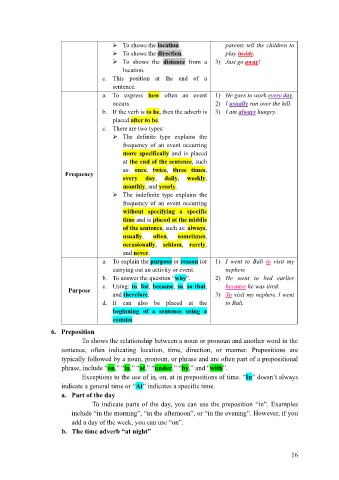
➢  To shows the location.              parents tell the children to
                                         ➢  To shows the direction.             play inside.
                                         ➢  To  shows  the  distance  from  a   3)  Just go away!
                                            location.
                                     c.  This  position  at  the  end  of  a
                                         sentence.
                                     a.  To  express  how  often  an  event   1)  He goes to work every day.
                                         occurs.                             2)  I usually run over the hill.
                                     b.  If the verb is to be, then the adverb is   3)  I am always hungry.
                                         placed after to be.
                                     c.  There are two types:
                                         ➢  The  definite  type  explains  the
                                            frequency  of  an  event  occurring
                                            more  specifically  and  is  placed
                                            at the end of the sentence, such
                                            as:  once,  twice,  three  times,
                        Frequency
                                            every  day,  daily,  weekly,
                                            monthly, and yearly.
                                         ➢  The  indefinite  type  explains  the
                                            frequency  of  an  event  occurring
                                            without  specifying  a  specific
                                            time and is placed at the middle
                                            of the sentence, such as: always,
                                            usually,   often,   sometimes,
                                            occasionally,  seldom,  rarely,
                                            and never.
                                     a.  To explain the purpose or reason for   1)  I  went  to  Bali  to  visit  my
                                         carrying out an activity or event.     nephew.
                                     b.  To answer the question “why”.       2)  He  went  to  bed  earlier
                                     c.  Using: to, for, because, so, so that,   because he was tired.
                         Purpose
                                         and therefore.                      3)  To visit my nephew, I went
                                     d.  It  can  also  be  placed  at  the     to Bali.
                                         beginning  of  a  sentence  using  a
                                         comma.

                   6.  Preposition
                              To shows the relationship between a noun or pronoun and another word in the
                       sentence,  often  indicating  location,  time,  direction,  or  manner.  Prepositions  are
                       typically followed by a noun, pronoun, or phrase and are often part of a prepositional
                       phrase, include “on,” “in,” “at,” “under,” “by,” and “with”.
                              Exceptions to the use of in, on, at in prepositions of time. “In” doesn’t always
                       indicate a general time or “At” indicates a specific time.
                       a.  Part of the day
                                 To indicate parts of the day, you can use the preposition “in”. Examples
                          include “in the morning”, “in the afternoon”, or “in the evening”. However, if you
                          add a day of the week, you can use “on”.
                       b.  The time adverb “at night”


                                                                                                       16

