


Page 18 - Doc1
P. 18
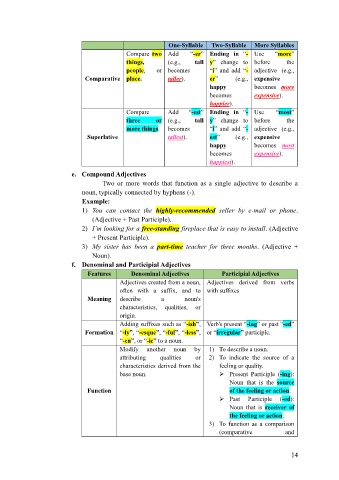
One-Syllable   Two-Syllable   More Syllables
                                             Compare  two  Add      “-er”  Ending  in  “- Use     “more”
                                             things,        (e.g.,   tall  y”  change  to  before     the
                                             people,    or  becomes        “i”  and  add  “- adjective  (e.g.,
                               Comparative  place.          taller).       er”      (e.g.,  expensive
                                                                           happy          becomes  more
                                                                           becomes        expensive).
                                                                           happier).
                                             Compare        Add    “-est”  Ending  in  “- Use     “most”
                                             three      or  (e.g.,   tall  y”  change  to  before     the
                                             more things.   becomes        “i”  and  add  “- adjective  (e.g.,
                                Superlative                 tallest).      est”     (e.g.,  expensive
                                                                           happy          becomes  most
                                                                           becomes        expensive).
                                                                           happiest).
                          e.  Compound Adjectives
                                     Two or more  words  that  function  as a single adjective to  describe  a
                              noun, typically connected by hyphens (-).
                              Example:
                              1)  You  can  contact  the  highly-recommended  seller  by  e-mail  or  phone.
                                 (Adjective + Past Participle).
                              2)  I’m looking for a free-standing fireplace that is easy to install. (Adjective
                                 + Present Participle).
                              3)  My  sister  has  been  a  part-time  teacher  for  three  months.  (Adjective  +
                                 Noun).
                          f.  Denominal and Participial Adjectives
                                Features       Denominal Adjectives            Participial Adjectives
                                           Adjectives created from a noun,  Adjectives  derived  from  verbs
                                           often  with  a  suffix,  and  to  with suffixes
                                Meaning    describe       a       noun's
                                           characteristics,  qualities,  or
                                           origin.
                                           Adding suffixes such as “-ish”,  Verb's present “-ing” or past “-ed”
                               Formation  “-ly”, “-esque”, “-ful”, “-less”,  or “irregular” participle.
                                           “-en”, or “-ic” to a noun.
                                           Modify    another   noun   by   1)  To describe a noun.
                                           attributing   qualities    or   2)  To  indicate  the  source  of  a
                                           characteristics derived from the   feeling or quality.
                                           base noun.                         ➢  Present  Participle  (-ing):
                                                                                  Noun  that  is  the  source
                                Function                                          of the feeling or action.
                                                                              ➢  Past   Participle   (-ed):
                                                                                  Noun  that  is  receiver  of
                                                                                  the feeling or action.
                                                                          3)  To  function  as  a  comparison
                                                                              (comparative           and


                                                                                                       14

