


Page 17 - Doc1
P. 17
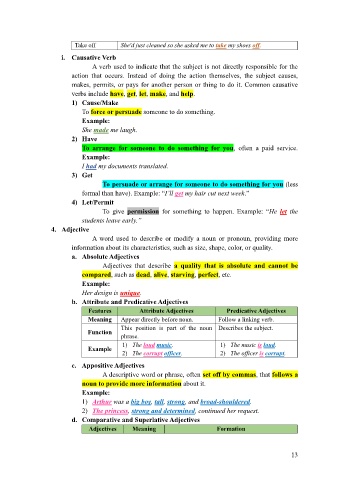
Take off        She'd just cleaned so she asked me to take my shoes off.

                       i.  Causative Verb
                                 A verb used to indicate that the subject is not directly responsible for the
                          action  that  occurs.  Instead  of  doing  the  action  themselves,  the  subject  causes,
                          makes, permits, or pays for another person or thing to do it. Common causative
                          verbs include have, get, let, make, and help.
                          1)  Cause/Make
                              To force or persuade someone to do something.
                              Example:
                              She made me laugh.
                          2)  Have
                              To  arrange  for  someone  to  do  something  for  you,  often  a  paid  service.
                              Example:
                              I had my documents translated.
                          3)  Get
                                     To persuade or arrange for someone to do something for you (less
                              formal than have). Example: “I’ll get my hair cut next week.”
                          4)  Let/Permit
                                     To  give  permission  for  something  to  happen.  Example:  “He  let  the
                              students leave early.”
                   4.  Adjective
                                 A  word  used  to  describe  or  modify  a  noun  or  pronoun,  providing  more
                          information about its characteristics, such as size, shape, color, or quality.
                          a.  Absolute Adjectives
                                     Adjectives  that  describe  a  quality  that  is  absolute  and  cannot  be
                              compared, such as dead, alive, starving, perfect, etc.
                              Example:
                              Her design is unique.
                          b.  Attribute and Predicative Adjectives
                                Features          Attribute Adjectives           Predicative Adjectives
                                Meaning    Appear directly before noun.       Follow a linking verb.
                                           This  position  is  part  of  the  noun  Describes the subject.
                                Function
                                           phrase.
                                            1)  The loud music.               1)  The music is loud.
                                Example
                                            2)  The corrupt officer.          2)  The officer is corrupt.
                          c.  Appositive Adjectives
                                     A descriptive word or phrase, often set off by commas, that follows a
                              noun to provide more information about it.
                              Example:
                              1)  Arthur was a big boy, tall, strong, and broad-shouldered.
                              2)  The princess, strong and determined, continued her request.
                          d.  Comparative and Superlative Adjectives
                                Adjectives     Meaning                       Formation


                                                                                                       13

