


Page 34 - UNI 101 Computer Science Handout.
P. 34
Faculty of Nursing
                                                                  Adult care Nursing Department


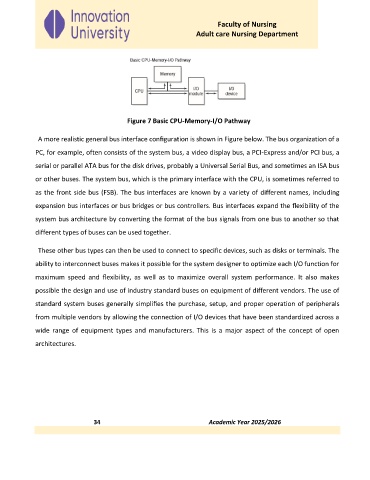
                                           Figure 7 Basic CPU-Memory-I/O Pathway


              A more realistic general bus interface configuration is shown in Figure below. The bus organization of a

             PC, for example, often consists of the system bus, a video display bus, a PCI-Express and/or PCI bus, a

             serial or parallel ATA bus for the disk drives, probably a Universal Serial Bus, and sometimes an ISA bus
             or other buses. The system bus, which is the primary interface with the CPU, is sometimes referred to

             as the front side bus (FSB). The bus interfaces are known by a variety of different names, including

             expansion bus interfaces or bus bridges or bus controllers. Bus interfaces expand the flexibility of the
             system bus architecture by converting the format of the bus signals from one bus to another so that

             different types of buses can be used together.


              These other bus types can then be used to connect to specific devices, such as disks or terminals. The

             ability to interconnect buses makes it possible for the system designer to optimize each I/O function for
             maximum  speed  and  flexibility,  as  well  as  to  maximize  overall  system  performance.  It  also  makes

             possible the design and use of industry standard buses on equipment of different vendors. The use of

             standard system buses generally simplifies the purchase, setup, and proper operation of peripherals

             from multiple vendors by allowing the connection of I/O devices that have been standardized across a

             wide  range  of  equipment  types  and  manufacturers.  This  is  a  major  aspect  of  the  concept  of  open
             architectures.


                                34                                                                        Academic Year 2025/2026

