


Page 110 - Handout Computer Network.
P. 110
5.3.1 Path Determination


                      Path determination occurs at Layer 3 (the network layer). It lets a router evaluate the available
               paths to a destination and establish the preferred handling of a packet.
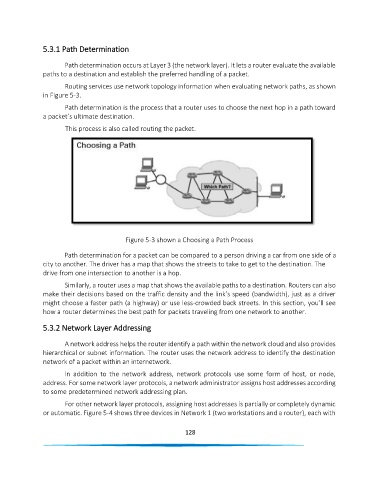
                      Routing services use network topology information when evaluating network paths, as shown
               in Figure 5-3.

                      Path determination is the process that a router uses to choose the next hop in a path toward
               a packet’s ultimate destination.

                       This process is also called routing the packet.


                                           Figure 5-3 shown a Choosing a Path Process

                      Path determination for a packet can be compared to a person driving a car from one side of a
               city to another. The driver has a map that shows the streets to take to get to the destination. The
               drive from one intersection to another is a hop.
                      Similarly, a router uses a map that shows the available paths to a destination. Routers can also
               make their decisions based on the traffic density and the link’s speed (bandwidth), just as a driver
               might choose a faster path (a highway) or use less-crowded back streets. In this section, you’ll see
               how a router determines the best path for packets traveling from one network to another.

               5.3.2 Network Layer Addressing

                      A network address helps the router identify a path within the network cloud and also provides
               hierarchical or subnet information. The router uses the network address to identify the destination
               network of a packet within an internetwork.
                      In  addition  to  the  network  address,  network  protocols  use  some  form  of  host,  or  node,
               address. For some network layer protocols, a network administrator assigns host addresses according
               to some predetermined network addressing plan.

                      For other network layer protocols, assigning host addresses is partially or completely dynamic
               or automatic. Figure 5-4 shows three devices in Network 1 (two workstations and a router), each with


                                                              128

