


Page 113 - Handout Computer Network.
P. 113
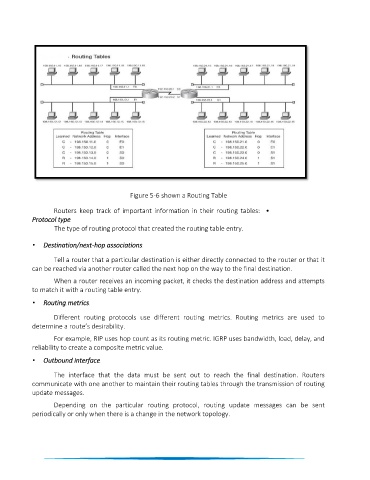
Figure 5-6 shown a Routing Table

                   Routers  keep  track  of  important  information  in  their  routing  tables:    •
            Protocol type
                   The type of routing protocol that created the routing table entry.


            •  Destination/next-hop associations

                   Tell a router that a particular destination is either directly connected to the router or that it
            can be reached via another router called the next hop on the way to the final destination.
                   When a router receives an incoming packet, it checks the destination address and attempts
            to match it with a routing table entry.

            •  Routing metrics

                   Different  routing  protocols  use  different  routing  metrics.  Routing  metrics  are  used  to
            determine a route’s desirability.
                   For example, RIP uses hop count as its routing metric. IGRP uses bandwidth, load, delay, and
            reliability to create a composite metric value.

            •  Outbound interface

                   The  interface  that  the  data  must  be  sent  out  to  reach  the  final  destination.  Routers
            communicate with one another to maintain their routing tables through the transmission of routing
            update messages.

                   Depending  on  the  particular  routing  protocol,  routing  update  messages  can  be  sent
            periodically or only when there is a change in the network topology.

