


Page 111 - Handout Computer Network.
P. 111
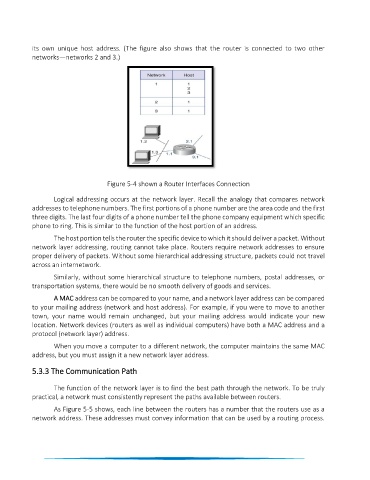
its  own  unique  host  address.  (The  figure  also  shows  that  the  router  is  connected  to  two  other
            networks—networks 2 and 3.)


                                     Figure 5-4 shown a Router Interfaces Connection

                   Logical addressing occurs at the network layer. Recall the analogy that compares network
            addresses to telephone numbers. The first portions of a phone number are the area code and the first
            three digits. The last four digits of a phone number tell the phone company equipment which specific
            phone to ring. This is similar to the function of the host portion of an address.
                   The host portion tells the router the specific device to which it should deliver a packet. Without
            network layer addressing, routing cannot take place. Routers require network addresses to ensure
            proper delivery of packets. Without some hierarchical addressing structure, packets could not travel
            across an internetwork.
                   Similarly, without some hierarchical structure to telephone numbers, postal addresses, or
            transportation systems, there would be no smooth delivery of goods and services.

                   A MAC address can be compared to your name, and a network layer address can be compared
            to your mailing address (network and host address). For example, if you were to move to another
            town,  your  name  would  remain  unchanged,  but  your  mailing  address  would  indicate  your  new
            location. Network devices (routers as well as individual computers) have both a MAC address and a
            protocol (network layer) address.

                   When you move a computer to a different network, the computer maintains the same MAC
            address, but you must assign it a new network layer address.


            5.3.3 The Communication Path

                   The function of the network layer is to find the best path through the network. To be truly
            practical, a network must consistently represent the paths available between routers.

                   As Figure 5-5 shows, each line between the routers has a number that the routers use as a
            network address. These addresses must convey information that can be used by a routing process.

