


Page 116 - Handout Computer Network.
P. 116
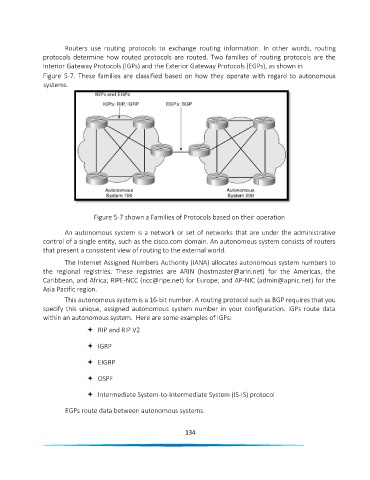
Routers use routing protocols to exchange routing information. In other words, routing
protocols determine how routed protocols are routed. Two families of routing protocols are the
Interior Gateway Protocols (IGPs) and the Exterior Gateway Protocols (EGPs), as shown in
Figure 5-7. These families are classified based on how they operate with regard to autonomous
systems.
Figure 5-7 shown a Families of Protocols based on their operation
An autonomous system is a network or set of networks that are under the administrative
control of a single entity, such as the cisco.com domain. An autonomous system consists of routers
that present a consistent view of routing to the external world.
The Internet Assigned Numbers Authority (IANA) allocates autonomous system numbers to
the regional registries. These registries are ARIN (hostmaster@arin.net) for the Americas, the
Caribbean, and Africa; RIPE-NCC (ncc@ripe.net) for Europe; and AP-NIC (admin@apnic.net) for the
Asia Pacific region.
This autonomous system is a 16-bit number. A routing protocol such as BGP requires that you
specify this unique, assigned autonomous system number in your configuration. IGPs route data
within an autonomous system. Here are some examples of IGPs:
RIP and RIP V2
IGRP
EIGRP
OSPF
Intermediate System-to-Intermediate System (IS-IS) protocol
EGPs route data between autonomous systems.
134

