


Page 119 - Handout Computer Network.
P. 119
5.7.1 RIP


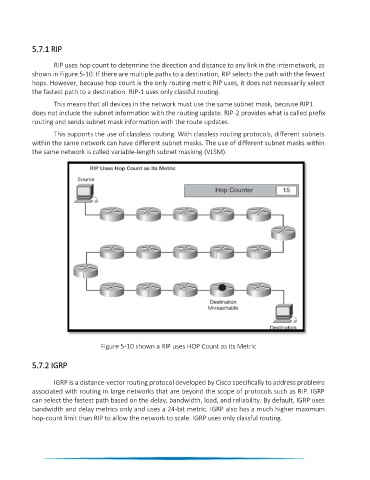
                   RIP uses hop count to determine the direction and distance to any link in the internetwork, as
            shown in Figure 5-10. If there are multiple paths to a destination, RIP selects the path with the fewest
            hops. However, because hop count is the only routing metric RIP uses, it does not necessarily select
            the fastest path to a destination. RIP-1 uses only classful routing.

                   This means that all devices in the network must use the same subnet mask, because RIP1
            does not include the subnet information with the routing update. RIP-2 provides what is called prefix
            routing and sends subnet mask information with the route updates.

                   This supports the use of classless routing. With classless routing protocols, different subnets
            within the same network can have different subnet masks. The use of different subnet masks within
            the same network is called variable-length subnet masking (VLSM).


                                  Figure 5-10 shown a RIP uses HOP Count as its Metric


            5.7.2 IGRP

                   IGRP is a distance-vector routing protocol developed by Cisco specifically to address problems
            associated with routing in large networks that are beyond the scope of protocols such as RIP. IGRP
            can select the fastest path based on the delay, bandwidth, load, and reliability. By default, IGRP uses
            bandwidth and delay metrics only and uses a 24-bit metric. IGRP also has a much higher maximum
            hop-count limit than RIP to allow the network to scale. IGRP uses only classful routing.

