


Page 121 - Handout Computer Network.
P. 121
Unreliable and best-effort do not mean that the system is unreliable and doesn’t work well,
            but that the IP protocol does not make any effort to see if the packet was delivered. This function is
            handled by the upper-layer protocols.

                   As information flows down the layers of the OSI model, the data is processed at each layer. At
            the network layer, the data is encapsulated within packets called datagrams.

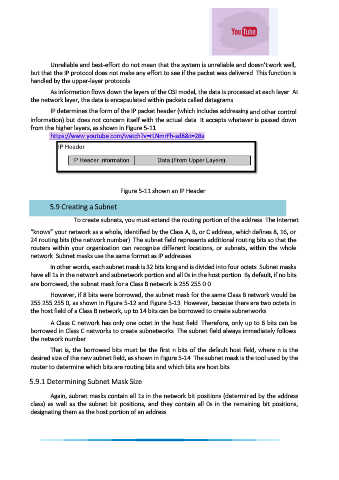
                   IP determines the form of the IP packet header (which includes addressing and other control
            information) but does not concern itself with the actual data. It accepts whatever is passed down
            from the higher layers, as shown in Figure 5-11.
                   https://www.youtube.com/watch?v=rLNmrFh-sd8&t=28s


                                            Figure 5-11 shown an IP Header

                   5.9 Creating a Subnet

                            To create subnets, you must extend the routing portion of the address. The Internet

            “knows” your network as a whole, identified by the Class A, B, or C address, which defines 8, 16, or
            24 routing bits (the network number). The subnet field represents additional routing bits so that the
            routers  within  your  organization  can recognize  different  locations,  or  subnets,  within  the  whole
            network. Subnet masks use the same format as IP addresses.

                   In other words, each subnet mask is 32 bits long and is divided into four octets. Subnet masks
            have all 1s in the network and subnetwork portion and all 0s in the host portion. By default, if no bits
            are borrowed, the subnet mask for a Class B network is 255.255.0.0.
                   However, if 8 bits were borrowed, the subnet mask for the same Class B network would be
            255.255.255.0, as shown in Figure 5-12 and Figure 5-13. However, because there are two octets in
            the host field of a Class B network, up to 14 bits can be borrowed to create subnetworks.

                   A Class C network has only one octet in the host field. Therefore, only up to 6 bits can be
            borrowed in Class C networks to create subnetworks. The subnet field always immediately follows
            the network number.

                   That is, the borrowed bits must be the first n bits of the default host field, where n is the
            desired size of the new subnet field, as shown in Figure 5-14. The subnet mask is the tool used by the
            router to determine which bits are routing bits and which bits are host bits.


            5.9.1 Determining Subnet Mask Size

                   Again, subnet masks contain all 1s in the network bit positions (determined by the address
            class)  as  well  as  the  subnet  bit  positions,  and  they  contain  all  0s  in  the  remaining  bit  positions,
            designating them as the host portion of an address.

