


Page 156 - Handout Computer Network.
P. 156
the other side of the globe, perhaps over slow and congested links. This can lead to significant
                 delays.

                 • Maintenance. The single DNS server would have to keep records for all Internet hosts. Not only
                 would this centralized database be huge, but it would have to be updated frequently to account
                 for every new host. In summary, a centralized database in a single DNS server simply doesn’t
                 scale. Consequently, the DNS is distributed by design. In fact, the DNS is a wonderful example of
                 how a distributed database can be implemented in the Internet.

                 A Distributed, Hierarchical Database
                 In order to deal with the issue of scale, the DNS uses a large number of servers, organized in a
                 hierarchical  fashion  and  distributed  around  the  world.  No  single  DNS  server  has  all  of  the
                 mappings for all of the hosts in the Internet. Instead, the map pings are distributed across the
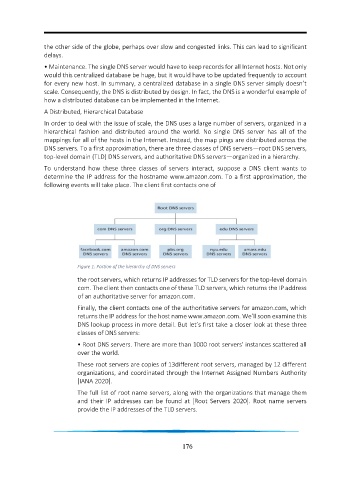
                 DNS servers. To a first approximation, there are three classes of DNS servers—root DNS servers,
                 top-level domain (TLD) DNS servers, and authoritative DNS servers—organized in a hierarchy.
                 To  understand  how  these  three  classes  of  servers  interact,  suppose  a  DNS  client  wants  to
                 determine the IP address for the hostname www.amazon.com. To a first approximation, the
                 following events will take place. The client first contacts one of


                            Figure 1: Portion of the hierarchy of DNS servers

                            the root servers, which returns IP addresses for TLD servers for the top-level domain
                            com. The client then contacts one of these TLD servers, which returns the IP address
                            of an authoritative server for amazon.com.

                            Finally, the client contacts one of the authoritative servers for amazon.com, which
                            returns the IP address for the host name www.amazon.com. We’ll soon examine this
                            DNS lookup process in more detail. But let’s first take a closer look at these three
                            classes of DNS servers:

                            • Root DNS servers. There are more than 1000 root servers’ instances scattered all
                            over the world.
                            These root servers are copies of 13different root servers, managed by 12 different
                            organizations, and coordinated through the Internet Assigned Numbers Authority
                            [IANA 2020].
                            The full list of root name servers, along with the organizations that manage them
                            and  their  IP  addresses  can  be  found  at  [Root  Servers  2020].  Root  name  servers
                            provide the IP addresses of the TLD servers.


                                                                 176

