


Page 160 - Handout Computer Network.
P. 160
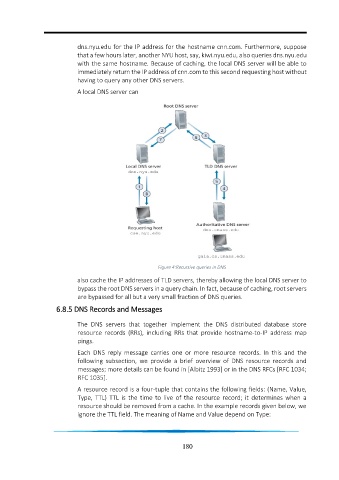
dns.nyu.edu for the IP address for the hostname cnn.com. Furthermore, suppose
                            that a few hours later, another NYU host, say, kiwi.nyu.edu, also queries dns.nyu.edu
                            with the same hostname. Because of caching, the local DNS server will be able to
                            immediately return the IP address of cnn.com to this second requesting host without
                            having to query any other DNS servers.

                            A local DNS server can


                                                         Figure 4:Recursive queries in DNS

                            also cache the IP addresses of TLD servers, thereby allowing the local DNS server to
                            bypass the root DNS servers in a query chain. In fact, because of caching, root servers
                            are bypassed for all but a very small fraction of DNS queries.

                     6.8.5 DNS Records and Messages

                            The  DNS  servers  that  together  implement  the  DNS  distributed  database  store
                            resource  records  (RRs),  including  RRs  that  provide  hostname-to-IP  address  map
                            pings.

                            Each  DNS  reply  message  carries  one  or  more  resource  records.  In  this  and  the
                            following  subsection,  we  provide  a  brief  overview  of  DNS  resource  records  and
                            messages; more details can be found in [Albitz 1993] or in the DNS RFCs [RFC 1034;
                            RFC 1035].

                            A resource record is a four-tuple that contains the following fields: (Name, Value,
                            Type,  TTL)  TTL  is  the  time  to  live  of  the  resource  record;  it  determines  when  a
                            resource should be removed from a cache. In the example records given below, we
                            ignore the TTL field. The meaning of Name and Value depend on Type:


                                                                 180

