


Page 162 - Handout Computer Network.
P. 162
A  1-bit  authoritative  flag  is  set  in  a  reply  message  when  a  DNS  server  is  an
                            authoritative server for a queried name.

                            A 1-bit recursion-desired flag is set when a client (host or DNS server) desires that
                            the DNS server perform recursion when it doesn’t have the record.
                            A 1-bit recursion-available field is set in a reply if the DNS server supports recursion.
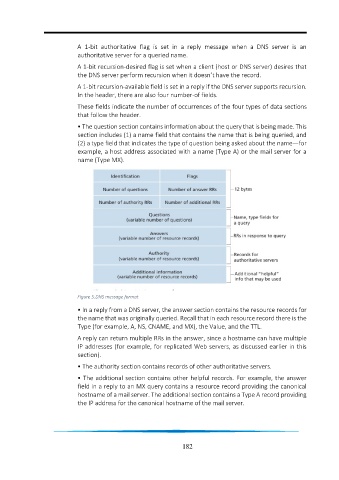
                            In the header, there are also four number-of fields.

                            These fields indicate the number of occurrences of the four types of data sections
                            that follow the header.

                            • The question section contains information about the query that is being made. This
                            section includes (1) a name field that contains the name that is being queried, and
                            (2) a type field that indicates the type of question being asked about the name—for
                            example, a host address associated with a name (Type A) or the mail server for a
                            name (Type MX).


                            Figure 5:DNS message format
                            • In a reply from a DNS server, the answer section contains the resource records for
                            the name that was originally queried. Recall that in each resource record there is the
                            Type (for example, A, NS, CNAME, and MX), the Value, and the TTL.

                            A reply can return multiple RRs in the answer, since a hostname can have multiple
                            IP addresses (for example, for replicated Web servers, as discussed earlier in this
                            section).

                            • The authority section contains records of other authoritative servers.
                            • The additional section contains other helpful records. For example, the answer
                            field in a reply to an MX query contains a resource record providing the canonical
                            hostname of a mail server. The additional section contains a Type A record providing
                            the IP address for the canonical hostname of the mail server.


                                                                 182

