


Page 157 - Handout Computer Network.
P. 157
Computer Network                                                             2026


                        •  Top-level  domain  (TLD)  servers.  For  each  of  the  top-level  domains—top-level
                        domains such as com, org, net, edu, and gov, and all of the country top-level domains
                        such as uk, fr, ca, and jp—there is TLD server (or server cluster).

                        The company Verisign Global Registry Services maintains the TLD servers for the com
                        top-level domain, and the company Educause maintains the TLD servers for the edu
                        top-level domain.
                        The  network  infrastructure  supporting  a  TLD  can  be  large  and  complex;  see
                        [Osterweil 2012] for a nice overview of the Verisign network.
                        See [TLD list 2020] for a list of all top-level domains. TLD servers provide the IP
                        addresses for authoritative DNS servers.

                        • Authoritative DNS servers. Every organization with publicly accessible hosts (such
                        as Web servers and mail servers) on the Internet must provide publicly accessible
                        DNS records that map the names of those hosts to IP addresses. An organization’s
                        authoritative DNS server houses these DNS records. An organization can choose to
                        implement its own authoritative DNS server to hold these records; alternatively, the
                        organization can pay to have these records stored in an


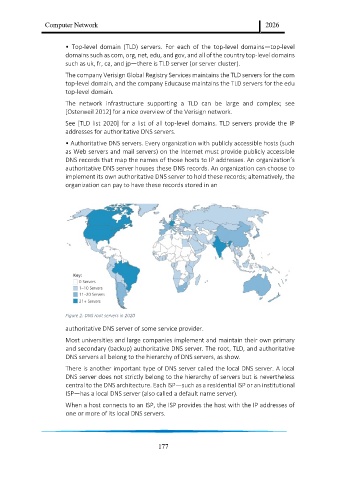
                        Figure 2: DNS root servers in 2020
                        authoritative DNS server of some service provider.

                        Most universities and large companies implement and maintain their own primary
                        and secondary (backup) authoritative DNS server. The root, TLD, and authoritative
                        DNS servers all belong to the hierarchy of DNS servers, as show.
                        There is another important type of DNS server called the local DNS server. A local
                        DNS server does not strictly belong to the hierarchy of servers but is nevertheless
                        central to the DNS architecture. Each ISP—such as a residential ISP or an institutional
                        ISP—has a local DNS server (also called a default name server).
                        When a host connects to an ISP, the ISP provides the host with the IP addresses of
                        one or more of its local DNS servers.


                                                         177

