


Page 188 - Handout Computer Network.
P. 188
Bluetooth networks are ad hoc networks—no network infrastructure (e.g., an access point) is
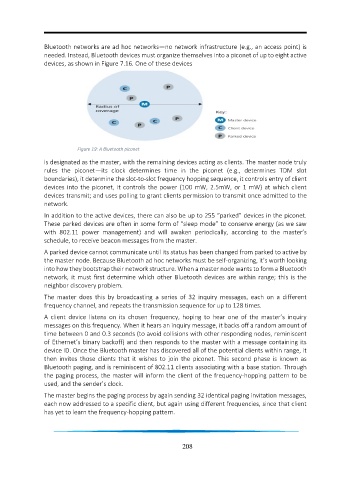
                 needed. Instead, Bluetooth devices must organize themselves into a piconet of up to eight active
                 devices, as shown in Figure 7.16. One of these devices


                            Figure 19: A Bluetooth piconet

                 is designated as the master, with the remaining devices acting as clients. The master node truly
                 rules  the  piconet—its  clock  determines  time  in  the  piconet  (e.g.,  determines  TDM  slot
                 boundaries), it determine the slot-to-slot frequency hopping sequence, it controls entry of client
                 devices into the piconet, it controls the power (100 mW, 2.5mW, or 1 mW) at which client
                 devices transmit; and uses polling to grant clients permission to transmit once admitted to the
                 network.

                 In addition to the active devices, there can also be up to 255 “parked” devices in the piconet.
                 These parked devices are often in some form of “sleep mode” to conserve energy (as we saw
                 with  802.11  power  management)  and  will  awaken  periodically,  according  to  the  master’s
                 schedule, to receive beacon messages from the master.

                 A parked device cannot communicate until its status has been changed from parked to active by
                 the master node. Because Bluetooth ad hoc networks must be self-organizing, it’s worth looking
                 into how they bootstrap their network structure. When a master node wants to form a Bluetooth
                 network, it must first determine which other Bluetooth devices are within range; this is the
                 neighbor discovery problem.
                 The  master  does  this  by  broadcasting  a  series  of  32  inquiry  messages,  each  on  a  different
                 frequency channel, and repeats the transmission sequence for up to 128 times.

                 A  client  device  listens  on  its  chosen  frequency,  hoping  to  hear  one  of  the  master’s  inquiry
                 messages on this frequency. When it hears an inquiry message, it backs off a random amount of
                 time between 0 and 0.3 seconds (to avoid collisions with other responding nodes, reminiscent
                 of Ethernet’s binary backoff) and then responds to the master with a message containing its
                 device ID. Once the Bluetooth master has discovered all of the potential clients within range, it
                 then  invites  those  clients  that  it  wishes  to  join  the  piconet.  This  second  phase  is  known  as
                 Bluetooth paging, and is reminiscent of 802.11 clients associating with a base station. Through
                 the paging process, the master will inform the client of the frequency-hopping pattern to be
                 used, and the sender’s clock.
                 The master begins the paging process by again sending 32 identical paging invitation messages,
                 each now addressed to a specific client, but again using different frequencies, since that client
                 has yet to learn the frequency-hopping pattern.


                                                                 208

