


Page 185 - Handout Computer Network.
P. 185
Computer Network                                                             2026


            This address change would disrupt (and eventually terminate) any on-going TCP connections at
            H1, we’ll see how a network-layer mobility protocol, such as mobile IP, can be used to avoid this
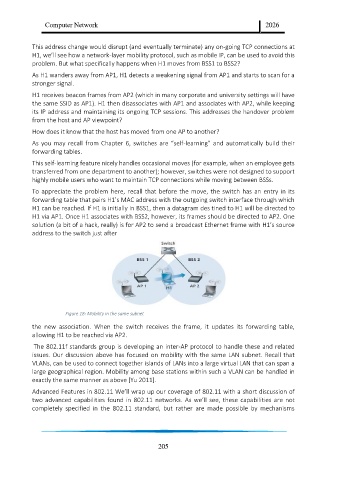
            problem. But what specifically happens when H1 moves from BSS1 to BSS2?

            As H1 wanders away from AP1, H1 detects a weakening signal from AP1 and starts to scan for a
            stronger signal.
            H1 receives beacon frames from AP2 (which in many corporate and university settings will have
            the same SSID as AP1). H1 then disassociates with AP1 and associates with AP2, while keeping
            its IP address and maintaining its ongoing TCP sessions. This addresses the handover problem
            from the host and AP viewpoint?
            How does it know that the host has moved from one AP to another?

            As you may recall from Chapter 6, switches are “self-learning” and automatically build their
            forwarding tables.
            This self-learning feature nicely handles occasional moves (for example, when an employee gets
            transferred from one department to another); however, switches were not designed to support
            highly mobile users who want to maintain TCP connections while moving between BSSs.
            To appreciate the problem here, recall that before the move, the switch has an entry in its
            forwarding table that pairs H1’s MAC address with the outgoing switch interface through which
            H1 can be reached. If H1 is initially in BSS1, then a datagram des tined to H1 will be directed to
            H1 via AP1. Once H1 associates with BSS2, however, its frames should be directed to AP2. One
            solution (a bit of a hack, really) is for AP2 to send a broadcast Ethernet frame with H1’s source
            address to the switch just after


                        Figure 18: Mobility in the same subnet

            the  new  association.  When  the  switch  receives  the  frame,  it  updates  its  forwarding  table,
            allowing H1 to be reached via AP2.
             The 802.11f standards group is developing an inter-AP protocol to handle these and related
            issues. Our discussion above has focused on mobility with the same LAN subnet. Recall that
            VLANs, can be used to connect together islands of LANs into a large virtual LAN that can span a
            large geographical region. Mobility among base stations within such a VLAN can be handled in
            exactly the same manner as above [Yu 2011].
            Advanced Features in 802.11 We’ll wrap up our coverage of 802.11 with a short discussion of
            two advanced capabilities found in 802.11 networks. As we’ll see, these capabilities are not
            completely  specified  in  the  802.11  standard,  but  rather  are  made  possible  by  mechanisms


                                                         205

