


Page 181 - Handout Computer Network.
P. 181
Computer Network                                                             2026


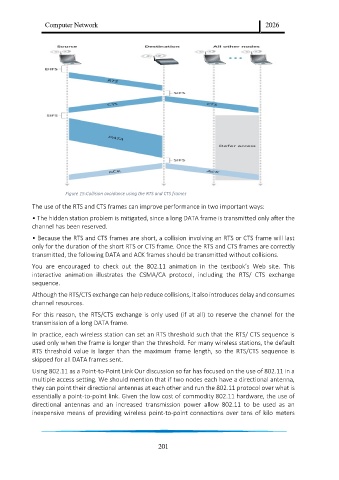
                        Figure 15:Collision avoidance using the RTS and CTS frames

            The use of the RTS and CTS frames can improve performance in two important ways:
            • The hidden station problem is mitigated, since a long DATA frame is transmitted only after the
            channel has been reserved.

            • Because the RTS and CTS frames are short, a collision involving an RTS or CTS frame will last
            only for the duration of the short RTS or CTS frame. Once the RTS and CTS frames are correctly
            transmitted, the following DATA and ACK frames should be transmitted without collisions.

            You  are  encouraged  to  check  out  the  802.11  animation  in  the  textbook’s  Web  site.  This
            interactive  animation  illustrates  the  CSMA/CA  protocol,  including  the  RTS/  CTS  exchange
            sequence.

            Although the RTS/CTS exchange can help reduce collisions, it also introduces delay and consumes
            channel resources.
            For this reason, the RTS/CTS exchange is only used (if at all) to reserve the channel for the
            transmission of a long DATA frame.

            In practice, each wireless station can set an RTS threshold such that the RTS/ CTS sequence is
            used only when the frame is longer than the threshold. For many wireless stations, the default
            RTS  threshold  value  is  larger  than  the  maximum  frame  length,  so  the  RTS/CTS  sequence  is
            skipped for all DATA frames sent.

            Using 802.11 as a Point-to-Point Link Our discussion so far has focused on the use of 802.11 in a
            multiple access setting. We should mention that if two nodes each have a directional antenna,
            they can point their directional antennas at each other and run the 802.11 protocol over what is
            essentially a point-to-point link. Given the low cost of commodity 802.11 hardware, the use of
            directional  antennas  and  an  increased  transmission  power  allow  802.11  to  be  used  as  an
            inexpensive means of providing wireless point-to-point connections over tens of kilo meters


                                                         201

