


Page 180 - Handout Computer Network.
P. 180
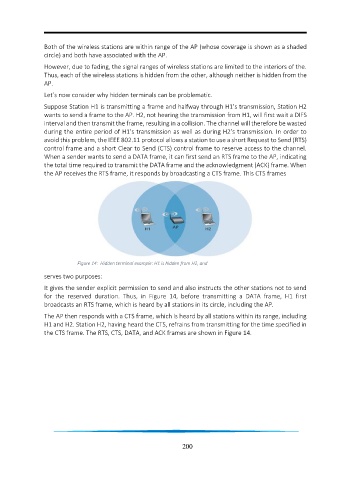
Both of the wireless stations are within range of the AP (whose coverage is shown as a shaded
                 circle) and both have associated with the AP.

                 However, due to fading, the signal ranges of wireless stations are limited to the interiors of the.
                 Thus, each of the wireless stations is hidden from the other, although neither is hidden from the
                 AP.
                 Let’s now consider why hidden terminals can be problematic.

                 Suppose Station H1 is transmitting a frame and halfway through H1’s transmission, Station H2
                 wants to send a frame to the AP. H2, not hearing the transmission from H1, will first wait a DIFS
                 interval and then transmit the frame, resulting in a collision. The channel will therefore be wasted
                 during the entire period of H1’s transmission as well as during H2’s transmission. In order to
                 avoid this problem, the IEEE 802.11 protocol allows a station to use a short Request to Send (RTS)
                 control frame and a short Clear to Send (CTS) control frame to reserve access to the channel.
                 When a sender wants to send a DATA frame, it can first send an RTS frame to the AP, indicating
                 the total time required to transmit the DATA frame and the acknowledgment (ACK) frame. When
                 the AP receives the RTS frame, it responds by broadcasting a CTS frame. This CTS frames


                            Figure 14:  Hidden terminal example: H1 is hidden from H2, and

                 serves two purposes:
                 It gives the sender explicit permission to send and also instructs the other stations not to send
                 for  the  reserved  duration.  Thus,  in  Figure  14,  before  transmitting  a  DATA  frame,  H1  first
                 broadcasts an RTS frame, which is heard by all stations in its circle, including the AP.

                 The AP then responds with a CTS frame, which is heard by all stations within its range, including
                 H1 and H2. Station H2, having heard the CTS, refrains from transmitting for the time specified in
                 the CTS frame. The RTS, CTS, DATA, and ACK frames are shown in Figure 14.


                                                                 200

