


Page 182 - Handout Computer Network.
P. 182
distance. [Raman 2007] describes one of the first such multi-hop wireless networks, operating in
                 the rural Ganges plains in India using point-to-point 802.11 links.

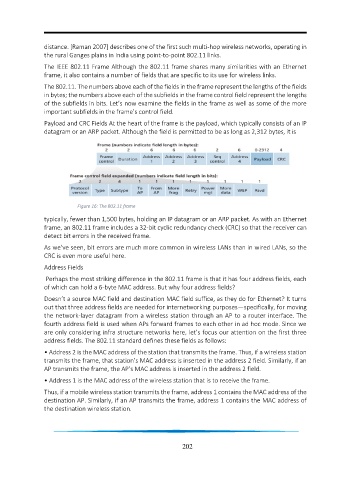
                 The IEEE 802.11 Frame Although the 802.11 frame shares many similarities with an Ethernet
                 frame, it also contains a number of fields that are specific to its use for wireless links.
                 The 802.11. The numbers above each of the fields in the frame represent the lengths of the fields
                 in bytes; the numbers above each of the subfields in the frame control field represent the lengths
                 of the subfields in bits. Let’s now examine the fields in the frame as well as some of the more
                 important subfields in the frame’s control field.
                 Payload and CRC Fields At the heart of the frame is the payload, which typically consists of an IP
                 datagram or an ARP packet. Although the field is permitted to be as long as 2,312 bytes, it is


                            Figure 16: The 802.11 frame
                 typically, fewer than 1,500 bytes, holding an IP datagram or an ARP packet. As with an Ethernet
                 frame, an 802.11 frame includes a 32-bit cyclic redundancy check (CRC) so that the receiver can
                 detect bit errors in the received frame.

                 As we’ve seen, bit errors are much more common in wireless LANs than in wired LANs, so the
                 CRC is even more useful here.

                 Address Fields
                  Perhaps the most striking difference in the 802.11 frame is that it has four address fields, each
                 of which can hold a 6-byte MAC address. But why four address fields?

                 Doesn’t a source MAC field and destination MAC field suffice, as they do for Ethernet? It turns
                 out that three address fields are needed for internetworking purposes—specifically, for moving
                 the network-layer datagram from a wireless station through an AP to a router interface. The
                 fourth address field is used when APs forward frames to each other in ad hoc mode. Since we
                 are only considering infra structure networks here, let’s focus our attention on the first three
                 address fields. The 802.11 standard defines these fields as follows:
                 • Address 2 is the MAC address of the station that transmits the frame. Thus, if a wireless station
                 transmits the frame, that station’s MAC address is inserted in the address 2 field. Similarly, if an
                 AP transmits the frame, the AP’s MAC address is inserted in the address 2 field.

                 • Address 1 is the MAC address of the wireless station that is to receive the frame.
                 Thus, if a mobile wireless station transmits the frame, address 1 contains the MAC address of the
                 destination AP. Similarly, if an AP transmits the frame, address 1 contains the MAC address of
                 the destination wireless station.


                                                                 202

