


Page 178 - Handout Computer Network.
P. 178
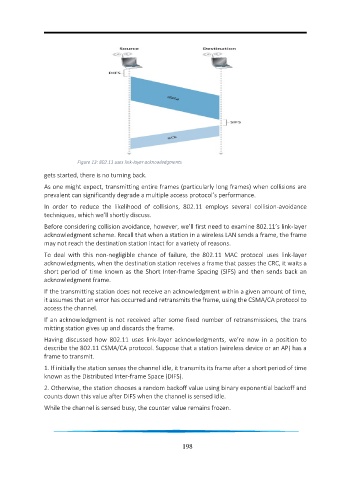
Figure 13: 802.11 uses link-layer acknowledgments

                 gets started, there is no turning back.
                 As one might expect, transmitting entire frames (particularly long frames) when collisions are
                 prevalent can significantly degrade a multiple access protocol’s performance.

                 In  order  to  reduce  the  likelihood  of  collisions,  802.11  employs  several  collision-avoidance
                 techniques, which we’ll shortly discuss.

                 Before considering collision avoidance, however, we’ll first need to examine 802.11’s link-layer
                 acknowledgment scheme. Recall that when a station in a wireless LAN sends a frame, the frame
                 may not reach the destination station intact for a variety of reasons.
                 To  deal  with  this  non-negligible  chance  of  failure,  the  802.11  MAC  protocol  uses  link-layer
                 acknowledgments, when the destination station receives a frame that passes the CRC, it waits a
                 short period of time known as the Short Inter-frame Spacing (SIFS) and then sends back an
                 acknowledgment frame.
                 If the transmitting station does not receive an acknowledgment within a given amount of time,
                 it assumes that an error has occurred and retransmits the frame, using the CSMA/CA protocol to
                 access the channel.

                 If an acknowledgment is not received after some fixed number of retransmissions, the trans
                 mitting station gives up and discards the frame.

                 Having  discussed  how  802.11  uses  link-layer  acknowledgments,  we’re  now  in  a  position  to
                 describe the 802.11 CSMA/CA protocol. Suppose that a station (wireless device or an AP) has a
                 frame to transmit.
                 1. If initially the station senses the channel idle, it transmits its frame after a short period of time
                 known as the Distributed Inter-frame Space (DIFS).
                 2. Otherwise, the station chooses a random backoff value using binary exponential backoff and
                 counts down this value after DIFS when the channel is sensed idle.

                 While the channel is sensed busy, the counter value remains frozen.


                                                                 198

