


Page 173 - Handout Computer Network.
P. 173
Computer Network                                                             2026


            This decreases interference and increases the distance reached at a given data rate. The data
            rates shown in Table1 are for an idealized environment, for example, a receiver close to the base
            station, with no interference—a scenario that we’re unlikely to experience in practice!

            So as the saying goes, YMMV: Your Mileage (or in this case your wireless data rate) May Vary.
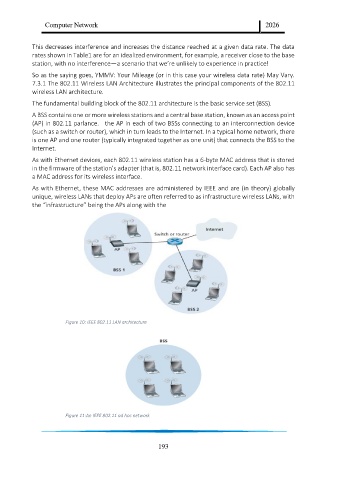
            7.3.1 The 802.11 Wireless LAN Architecture illustrates the principal components of the 802.11
            wireless LAN architecture.
            The fundamental building block of the 802.11 architecture is the basic service set (BSS).
            A BSS contains one or more wireless stations and a central base station, known as an access point
            (AP) in 802.11 parlance.   the AP in each of two BSSs connecting to an interconnection device
            (such as a switch or router), which in turn leads to the Internet. In a typical home network, there
            is one AP and one router (typically integrated together as one unit) that connects the BSS to the
            Internet.
            As with Ethernet devices, each 802.11 wireless station has a 6-byte MAC address that is stored
            in the firmware of the station’s adapter (that is, 802.11 network interface card). Each AP also has
            a MAC address for its wireless interface.

            As with Ethernet, these MAC addresses are administered by IEEE and are (in theory) globally
            unique, wireless LANs that deploy APs are often referred to as infrastructure wireless LANs, with
            the “infrastructure” being the APs along with the


                        Figure 10: IEEE 802.11 LAN architecture


                        Figure 11:An IEEE 802.11 ad hoc network


                                                         193

