


Page 172 - Handout Computer Network.
P. 172
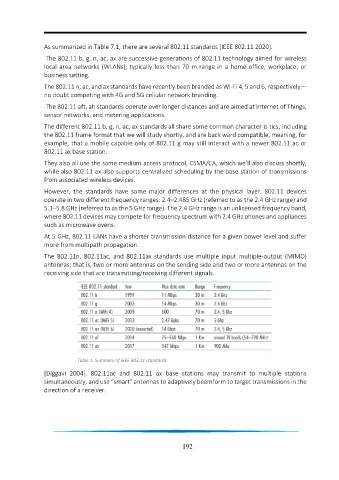
As summarized in Table 7.1, there are several 802.11 standards [IEEE 802.11 2020].
                  The 802.11 b, g, n, ac, ax are successive generations of 802.11 technology aimed for wireless
                 local area networks (WLANs), typically less than 70 m range in a home office, workplace, or
                 business setting.
                 The 802.11 n, ac, and ax standards have recently been branded as Wi-Fi 4, 5 and 6, respectively—
                 no doubt competing with 4G and 5G cellular network branding.

                  The 802.11 aft, ah standards operate over longer distances and are aimed at Internet of Things,
                 sensor networks, and metering applications.

                 The different 802.11 b, g, n, ac, ax standards all share some common character is tics, including
                 the 802.11 frame format that we will study shortly, and are back ward compatible, meaning, for
                 example, that a mobile capable only of 802.11 g may still interact with a newer 802.11 ac or
                 802.11 ax base station.
                 They also all use the same medium access protocol, CSMA/CA, which we’ll also discuss shortly,
                 while also 802.11 ax also supports centralized scheduling by the base station of transmissions
                 from associated wireless devices.
                 However,  the  standards  have  some  major  differences  at  the  physical  layer.  802.11  devices
                 operate in two different frequency ranges: 2.4–2.485 GHz (referred to as the 2.4 GHz range) and
                 5.1–5.8 GHz (referred to as the 5 GHz range). The 2.4 GHz range is an unlicensed frequency band,
                 where 802.11 devices may compete for frequency spectrum with 2.4 GHz phones and appliances
                 such as microwave ovens.
                 At 5 GHz, 802.11 LANs have a shorter transmission distance for a given power level and suffer
                 more from multipath propagation.

                 The  802.11n,  802.11ac,  and  802.11ax  standards  use  multiple  input  multiple-output  (MIMO)
                 antennas; that is, two or more antennas on the sending side and two or more antennas on the
                 receiving side that are transmitting/receiving different signals.


                            Table 1: Summary of IEEE 802.11 standards

                 [Diggavi  2004].  802.11ac  and  802.11  ax  base  stations  may  transmit  to  multiple  stations
                 simultaneously, and use “smart” antennas to adaptively beamform to target transmissions in the
                 direction of a receiver.


                                                                 192

