


Page 191 - Handout Computer Network.
P. 191
Computer Network                                                             2026


            However, in this text book, we’ll use the more reader-friendly term “mobile device” throughout.
            We also note here that a mobile device is not always mobile; for example, the device might be a
            fixed temperature sensor or a surveillance camera.

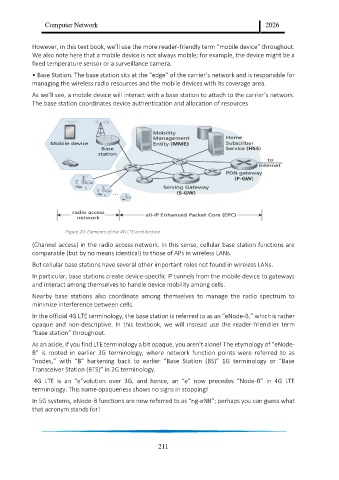
            • Base Station. The base station sits at the “edge” of the carrier’s network and is responsible for
            managing the wireless radio resources and the mobile devices with its coverage area.
            As we’ll see, a mobile device will interact with a base station to attach to the carrier’s network.
            The base station coordinates device authentication and allocation of resources


                        Figure 20: Elements of the 4G LTE architecture

            (Channel access) in the radio access network. In this sense, cellular base station functions are
            comparable (but by no means identical) to those of APs in wireless LANs.
            But cellular base stations have several other important roles not found in wireless LANs.

            In particular, base stations create device-specific IP tunnels from the mobile device to gateways
            and interact among themselves to handle device mobility among cells.
            Nearby  base  stations  also  coordinate  among  themselves  to  manage  the  radio  spectrum  to
            minimize interference between cells.

            In the official 4G LTE terminology, the base station is referred to as an “eNode-B,” which is rather
            opaque  and  non-descriptive.  In  this  textbook, we  will  instead  use the  reader-friendlier  term
            “base station” throughout.

            As an aside, if you find LTE terminology a bit opaque, you aren’t alone! The etymology of “eNode-
            B”  is  rooted  in  earlier  3G  terminology,  where  network  function  points  were  referred  to  as
            “nodes,”  with  “B”  harkening  back  to  earlier  “Base  Station  (BS)”  1G  terminology  or  “Base
            Transceiver Station (BTS)” in 2G terminology.

             4G  LTE  is  an  “e”volution  over  3️G,  and  hence,  an  “e”  now  precedes  “Node-B”  in  4G  LTE
            terminology. This name opaqueness shows no signs in stopping!
            In 5G systems, eNode-B functions are now referred to as “ng-eNB”; perhaps you can guess what
            that acronym stands for!


                                                         211

