


Page 27 - Future Stars Science Explorer-5
P. 27
Now, Move your knee in different directions. Then move your neck in as
            many ways as you can. Is there a difference? The neck can be moved in many
            directions whereas the knee cannot. This is because the movable joints in the

            neck and knee are of different types.

            Movable joints are of four kinds.


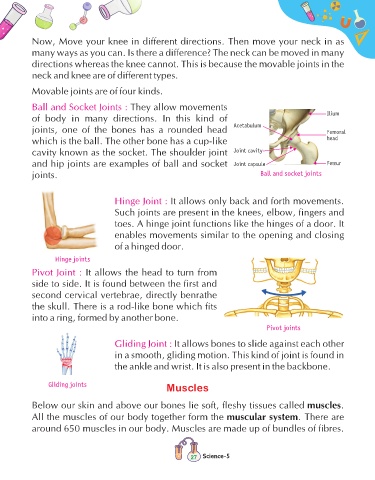
            Ball and Socket Joints : They allow movements
            of  body  in  many  directions.  In  this  kind  of                                                   Ilium

            joints, one of the bones has a rounded head                           Acetabulum                      Femoral
            which is the ball. The other bone has a cup-like                                                      head

            cavity known as the socket. The shoulder joint                        Joint cavity

            and hip joints are examples of ball and socket  Joint capsule                                         Femur
            joints.                                                                        Ball and socket joints


                                         Hinge Joint : It allows only back and forth movements.
                                         Such joints are present in the knees, elbow, fingers and

                                         toes. A hinge joint functions like the hinges of a door. It
                                         enables movements similar to the opening and closing

                                         of a hinged door.

                    Hinge joints

            Pivot Joint : It allows the head to turn from
            side to side. It is found between the first and
            second cervical vertebrae, directly benrathe

            the skull. There is a rod-like bone which fits
            into a ring, formed by another bone.

                                                                                             Pivot joints

                                         Gliding Joint : It allows bones to slide against each other
                                         in a smooth, gliding motion. This kind of joint is found in

                                         the ankle and wrist. It is also present in the backbone.


                  Gliding joints
                                                          Muscles

            Below our skin and above our bones lie soft, fleshy tissues called muscles.

            All the muscles of our body together form the muscular system. There are
            around 650 muscles in our body. Muscles are made up of bundles of fibres.


                                                                   27  Science-5

