


Page 30 - Future Stars Science Explorer-5
P. 30
4.   Joints are the places where __________               bones are joined together.
                         a. two                            b. three                        c. four

                    5.   __________          joint allows the head to turn from side to side.

                         a. Hinge                          b. Pivot                        c. Gliding


                           T

            B.     Write  for true and  for false statements.
                                            F
                    1.   The organs in the body do not work alone.
                    2.   Skull is made up of 30 bones joined together.
                    3.   The legs are known as the forelimbs.

                    4.   Femur is the longest bone in the body.

                    5.   Voluntary muscles are also called smooth muscles.


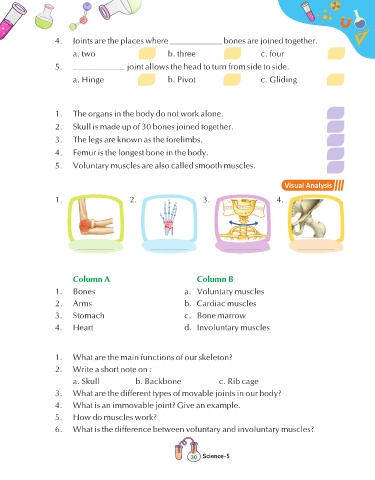
            C.     Name the joint in each of the following pictures.                               Visual Analysis

                    1.                        2.                       3.                       4.


                            _______                  _______                  _______                   _______


            D.     Match the following columns.
                         Column A                                    Column B

                    1.   Bones                                   a.  Voluntary muscles
                    2.   Arms                                    b.  Cardiac muscles

                    3.   Stomach                                 c.  Bone marrow

                    4.   Heart                                   d.  Involuntary muscles


            E.     Answer the following questions.
                    1.   What are the main functions of our skeleton?
                    2.   Write a short note on :

                         a. Skull               b. Backbone                  c. Rib cage

                    3.   What are the different types of movable joints in our body?
                    4.   What is an immovable joint? Give an example.

                    5.   How do muscles work?

                    6.   What is the difference between voluntary and involuntary muscles?


                                                                   30  Science-5

