


Page 58 - M. Abrahim Thesis
P. 58
Chapter (3) Networking Media and Data Link Layers Protocols


                3.3.1 Fiber-Optic Cables

                        Fiber-optic  cable  is  a  networking  medium  that  uses  modulated  light  for  data
                transmissions through thin strands of glass. Signals that represent data bits are converted into
                beams of light. It is important to recognize that while electricity is required to generate and
                interpret the fiber-optic signals at the end devices, no electricity is in the cable itself as there is
                with  copper  media.  In  fact,  fiber-optic  cable  components  are  very  good  insulators.  Many
                characteristics  of  fiber-optic  media  are  superior  to  copper.  Every  fiber-optic  cable  used  for
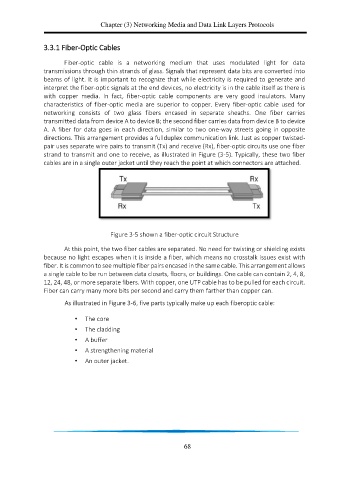
                networking  consists  of  two  glass  fibers  encased  in  separate  sheaths.  One  fiber  carries
                transmitted data from device A to device B; the second fiber carries data from device B to device
                A.  A  fiber  for  data  goes  in  each  direction,  similar  to  two  one-way streets  going  in  opposite
                directions. This arrangement provides a fullduplex communication link. Just as copper twisted-
                pair uses separate wire pairs to transmit (Tx) and receive (Rx), fiber-optic circuits use one fiber
                strand to transmit and one to receive, as illustrated in Figure (3-5). Typically, these two fiber
                cables are in a single outer jacket until they reach the point at which connectors are attached.


                                        Figure 3-5 shown a fiber-optic circuit Structure

                        At this point, the two fiber cables are separated. No need for twisting or shielding exists
                because no light escapes when it is inside a fiber, which means no crosstalk issues exist with
                fiber. It is common to see multiple fiber pairs encased in the same cable. This arrangement allows
                a single cable to be run between data closets, floors, or buildings. One cable can contain 2, 4, 8,
                12, 24, 48, or more separate fibers. With copper, one UTP cable has to be pulled for each circuit.
                Fiber can carry many more bits per second and carry them farther than copper can.

                        As illustrated in Figure 3-6, five parts typically make up each fiberoptic cable:

                           •  The core

                           •  The cladding
                           •  A buffer
                           •  A strengthening material
                           •  An outer jacket.


                                                                  68

