


Page 61 - M. Abrahim Thesis
P. 61
Computer Network                                                             2021


                   https://www.youtube.com/watch?v=vJuiDeKAVP4


            3.3.1.2      Single-Mode Fiber

                   Single-mode fiber uses only one mode of light to propagate through the fiber-optic core.
            In single-mode fiber-optic cabling, the core is much smaller than in multimode. The single-mode
            core is 8 to 10 microns in diameter. Nine-micron cores are the most common. A 9/125 marking
            on a single-mode fiber’s jacket indicates that the core fiber has a diameter of 9 microns and the
            surrounding cladding is 125 microns in diameter. The size of the core in single-mode fiber leaves
            very little room for light to bounce around. Furthermore, a very focused infrared laser is used as
            the light source in single mode fiber. The ray of light it generates enters the core at a 90-degree
            angle.  As  a  result  the  data  carrying  light  ray  pulses  in  single-mode  fiber  are  essentially
            transmitted in a straight line right down the middle of the core, as shown in Figure 3-8. This
            greatly increases both the speed and the distance that data can be transmitted.


                              Figure 3-8 shown a fiber-optic cable Single Mode Structure

                     Because of its design, single-mode fiber is capable of higher rates of data transmission

            (bandwidth) and greater cable run distances than multimode fiber. Single-mode fiber can carry
            LAN  data  up  to  3000  meters.  Multimode  is  only  capable  of  up  to  2000 meters.  Lasers  and
            singlemode  fibers  are  more  expensive  than  LEDs  and  multimode  fiber.  Because  of  these
            characteristics,  single-mode  fiber  is  often  used  for  interbuilding  connectivity  or  WANs  (for
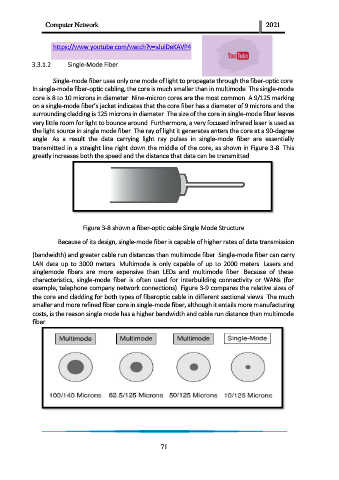
            example, telephone company network connections). Figure 3-9 compares the relative sizes of
            the core and cladding for both types of fiberoptic cable in different sectional views. The much
            smaller and more refined fiber core in single-mode fiber, although it entails more manufacturing
            costs, is the reason single mode has a higher bandwidth and cable run distance than multimode
            fiber.


                                                         71

