


Page 64 - M. Abrahim Thesis
P. 64
Chapter (3) Networking Media and Data Link Layers Protocols


                802.11g provides the same throughout as 802.11a but with backwards compatibility for 802.11g
                devices using Orthogonal Frequency Division Multiplexing (OFDM) modulation technology. Cisco
                has developed an access point that permits 802.11b and 802.11a devices to coexist on the same
                WLAN.  The  access  point  supplies  gateway  services  allowing  these  otherwise  incompatible
                devices to communicate.
                https://www.youtube.com/watch?v=hhks5xSpM-0
                 3.6   LAN Physical Layer

                        Ethernet is the most widely used LAN technology. Ethernet was first implemented by a
                group called DIX (Digital, Intel, and Xerox). DIX created and implemented the first Ethernet
                LAN specification, which was used as the basis for the Institute of Electrical and Electronics
                Engineer  (IEEE)  802.3  specification  released  in  1980.  Later,  the  IEEE  extended  the  802.3
                committee to three new committees known as 802.3u (Fast Ethernet), 802.3z (Gigabit Ethernet
                over Fiber), and 802.3ab (Gigabit Ethernet over UTP). The cabling aspect of the LAN exists at
                Layer 1 of the Open System Interconnection (OSI) reference model. Many topologies support
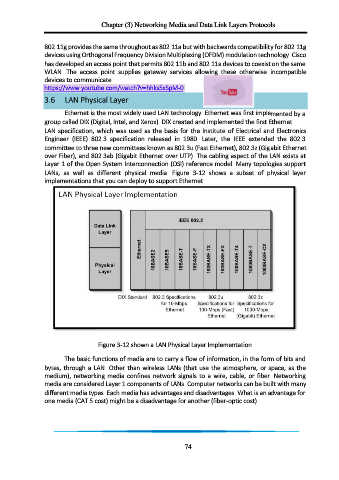
                LANs,  as  well  as  different  physical  media.  Figure  3-12  shows  a  subset  of  physical  layer
                implementations that you can deploy to support Ethernet.


                                   Figure 3-12 shown a LAN Physical Layer Implementation

                        The basic functions of media are to carry a flow of information, in the form of bits and
                bytes, through a LAN. Other than wireless LANs (that use the atmosphere, or space, as the
                medium),  networking  media  confines  network  signals  to  a  wire, cable,  or  fiber. Networking
                media are considered Layer 1 components of LANs. Computer networks can be built with many
                different media types. Each media has advantages and disadvantages. What is an advantage for
                one media (CAT 5 cost) might be a disadvantage for another (fiber-optic cost).


                                                                  74

