


Page 66 - M. Abrahim Thesis
P. 66
Chapter (3) Networking Media and Data Link Layers Protocols


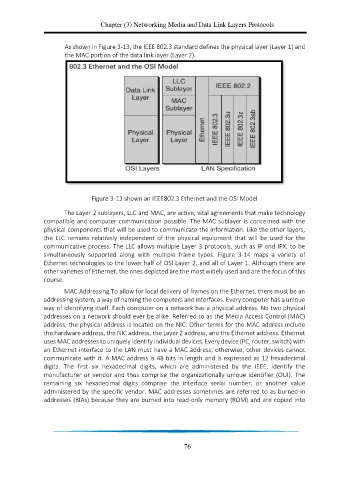
                        As shown in Figure 3-13, the IEEE 802.3 standard defines the physical layer (Layer 1) and
                        the MAC portion of the data link layer (Layer 2).


                                 Figure 3-13 shown an IEEE802.3 Ethernet and the OSI Model

                        The Layer 2 sublayers, LLC and MAC, are active, vital agreements that make technology
                compatible and computer communication possible. The MAC sublayer is concerned with the
                physical components that will be used to communicate the information. Like the other layers,
                the LLC remains  relatively  independent  of  the physical  equipment  that will  be  used  for  the
                communicative process. The LLC allows multiple Layer 3 protocols, such as IP and IPX, to be
                simultaneously  supported  along  with  multiple  frame  types.  Figure  3-14  maps  a  variety  of
                Ethernet technologies to the lower half of OSI Layer 2, and all of Layer 1. Although there are
                other varieties of Ethernet, the ones depicted are the most widely used and are the focus of this
                course.
                        MAC Addressing To allow for local delivery of frames on the Ethernet, there must be an
                addressing system, a way of naming the computers and interfaces. Every computer has a unique
                way of identifying itself. Each computer on a network has a physical address. No two physical
                addresses on a network should ever be alike. Referred to as the Media Access Control (MAC)
                address, the physical address is located on the NIC. Other terms for the MAC address include
                the hardware address, the NIC address, the Layer 2 address, and the Ethernet address. Ethernet
                uses MAC addresses to uniquely identify individual devices. Every device (PC, router, switch) with
                an Ethernet interface to the LAN must have a MAC address; otherwise, other devices cannot
                communicate with it. A MAC address is 48 bits in length and is expressed as 12 hexadecimal
                digits.  The  first  six  hexadecimal  digits,  which  are  administered  by  the  IEEE,  identify  the
                manufacturer or vendor and thus comprise the organizationally unique identifier (OUI). The
                remaining  six  hexadecimal  digits  comprise  the  interface  serial  number,  or  another  value
                administered by the specific vendor. MAC addresses sometimes are referred to as burned-in
                addresses (BIAs) because they are burned into read-only memory (ROM) and are copied into


                                                                  76

