


Page 71 - M. Abrahim Thesis
P. 71
Computer Network                                                             2021


                   Half-duplex transmission is an improvement over simplex transmission; the traffic can
            travel in both directions. Half-duplex transmission enables signals to travel in either direction,
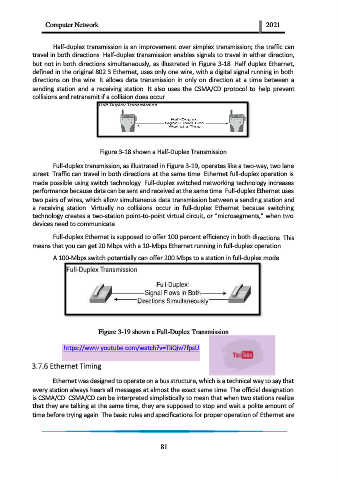
            but not in both directions simultaneously, as illustrated in Figure 3-18. Half duplex Ethernet,
            defined in the original 802.3 Ethernet, uses only one wire, with a digital signal running in both
            directions on the wire. It allows data transmission in only on direction at a time between a
            sending  station  and  a  receiving  station.  It  also  uses  the  CSMA/CD  protocol  to  help  prevent
            collisions and retransmit if a collision does occur.


                                    Figure 3-18 shown a Half-Duplex Transmission

                   Full-duplex transmission, as illustrated in Figure 3-19, operates like a two-way, two lane
            street. Traffic can travel in both directions at the same time. Ethernet full-duplex operation is
            made possible using switch technology. Full-duplex switched networking technology increases
            performance because data can be sent and received at the same time. Full-duplex Ethernet uses
            two pairs of wires, which allow simultaneous data transmission between a sending station and
            a  receiving  station.  Virtually  no  collisions  occur  in  full-duplex  Ethernet  because  switching
            technology creates a two-station point-to-point virtual circuit, or “microsegments,” when two
            devices need to communicate.


                   Full-duplex Ethernet is supposed to offer 100 percent efficiency in both directions. This
            means that you can get 20 Mbps with a 10-Mbps Ethernet running in full-duplex operation.

                    A 100-Mbps switch potentially can offer 200 Mbps to a station in full-duplex mode.


                                    Figure  3 - 19  shown a  Full - Duplex Transmission


                       https://www.youtube.com/watch?v=TIiQiw7fpsU


            3.7.6 Ethernet Timing

                   Ethernet was designed to operate on a bus structure, which is a technical way to say that
            every station always hears all messages at almost the exact same time. The official designation
            is CSMA/CD. CSMA/CD can be interpreted simplistically to mean that when two stations realize
            that they are talking at the same time, they are supposed to stop and wait a polite amount of
            time before trying again. The basic rules and specifications for proper operation of Ethernet are


                                                         81

