


Page 60 - M. Abrahim Thesis
P. 60
Chapter (3) Networking Media and Data Link Layers Protocols


                     3.3.1.1     Multimode Fiber

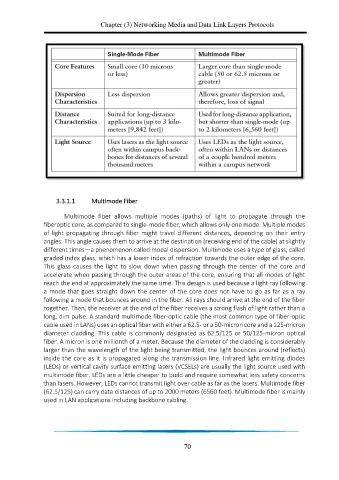
                        Multimode  fiber  allows  multiple  modes  (paths)  of  light  to  propagate  through  the
                fiberoptic core, as compared to single-mode fiber, which allows only one mode. Multiple modes
                of light propagating through fiber might travel different distances, depending on  their entry
                angles. This angle causes them to arrive at the destination (receiving end of the cable) at slightly
                different times—a phenomenon called modal dispersion. Multimode uses a type of glass, called
                graded index glass, which has a lower index of refraction towards the outer edge of the core.
                This  glass  causes  the  light  to  slow  down  when  passing  through  the  center  of  the  core  and
                accelerate when passing through the outer areas of the core, ensuring that all modes of light
                reach the end at approximately the same time. This design is used because a light ray following
                a mode that goes straight down the center of the core does not have to go as far as a ray
                following a mode that bounces around in the fiber. All rays should arrive at the end of the fiber
                together. Then, the receiver at the end of the fiber receives a strong flash of light rather than a
                long, dim pulse. A standard multimode fiber-optic cable (the most common type of fiber-optic
                cable used in LANs) uses an optical fiber with either a 62.5- or a 50-micron core and a 125-micron
                diameter cladding. This cable is commonly designated as 62.5/125 or 50/125-micron optical
                fiber. A micron is one millionth of a meter. Because the diameter of the cladding is considerably
                larger than the wavelength of the light being transmitted, the light bounces around (reflects)
                inside the core as it is propagated along the transmission line. Infrared light emitting diodes
                (LEDs) or vertical cavity surface emitting lasers (VCSELs) are usually the light source used with
                multimode fiber. LEDs are a little cheaper to build and require somewhat less safety concerns
                than lasers. However, LEDs cannot transmit light over cable as far as the lasers. Multimode fiber
                (62.5/125) can carry data distances of up to 2000 meters (6560 feet). Multimode fiber is mainly
                used in LAN applications including backbone cabling.


                                                                  70

