


Page 30 - demo
P. 30
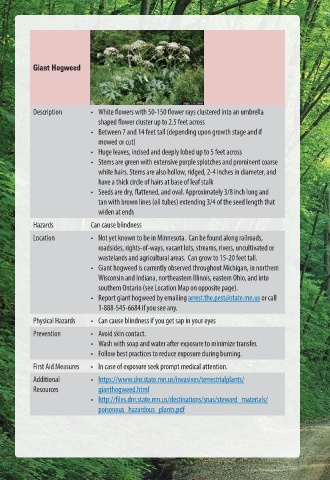
Giant Hogweed


         Description   •  White flowers with 50-150 flower rays clustered into an umbrella
                         shaped flower cluster up to 2.5 feet across
                       •  Between 7 and 14 feet tall (depending upon growth stage and if
                         mowed or cut)
                       •  Huge leaves, incised and deeply lobed up to 5 feet across
                       •  Stems are green with extensive purple splotches and prominent coarse
                         white hairs. Stems are also hollow, ridged, 2-4 inches in diameter, and
                         have a thick circle of hairs at base of leaf stalk
                       •  Seeds are dry, flattened, and oval. Approximately 3/8 inch long and
                         tan with brown lines (oil tubes) extending 3/4 of the seed length that
                         widen at ends
         Hazards       Can cause blindness
         Location      •  Not yet known to be in Minnesota.  Can be found along railroads,
                         roadsides, rights-of-ways, vacant lots, streams, rivers, uncultivated or
                         wastelands and agricultural areas.  Can grow to 15-20 feet tall.
                       •  Giant hogweed is currently observed throughout Michigan, in northern
                         Wisconsin and Indiana, northeastern Illinois, eastern Ohio, and into
                         southern Ontario (see Location Map on opposite page).
                       •  Report giant hogweed by emailing arrest.the.pest@state.mn.us or call
                         1-888-545-6684 if you see any.
         Physical Hazards  •  Can cause blindness if you get sap in your eyes
         Prevention    •  Avoid skin contact.
                       •  Wash with soap and water after exposure to minimize transfer.
                       •  Follow best practices to reduce exposure during burning.
         First Aid Measures  •  In case of exposure seek prompt medical attention.
         Additional    •  https://www.dnr.state.mn.us/invasives/terrestrialplants/
         Resources       gianthogweed.html
                       •  http://files.dnr.state.mn.us/destinations/snas/steward_materials/
                         poisonous_hazardous_plants.pdf

