


Page 8 - HealthnetworkMagazineSpring2020-p7.indd
P. 8
Changing the Odds


           G        eorge Myers was told he could
                    expect to wait 10-13 years for a
                    kidney transplant in the San
                    Francisco area. He was also told
        his body could only realistically handle dialysis
        for 10-15 years. It was a gamble he did not
        want to make. So he created a different game,
        this one with better odds.

        Losing Control

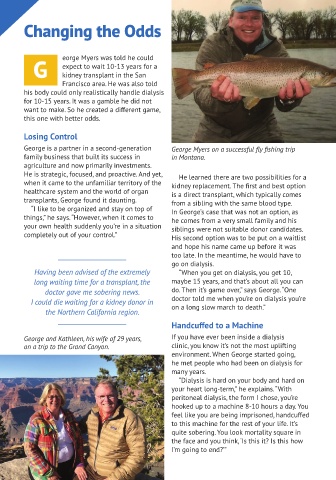
        George is a partner in a second-generation   George Myers on a successful fly fishing trip
        family business that built its success in    in Montana.
        agriculture and now primarily investments.
        He is strategic, focused, and proactive. And yet,   He learned there are two possibilities for a
        when it came to the unfamiliar territory of the   kidney replacement. The first and best option
        healthcare system and the world of organ    is a direct transplant, which typically comes
        transplants, George found it daunting.      from a sibling with the same blood type.
          “I like to be organized and stay on top of   In George’s case that was not an option, as
        things,” he says. “However, when it comes to   he comes from a very small family and his
        your own health suddenly you’re in a situation   siblings were not suitable donor candidates.
        completely out of your control.”            His second option was to be put on a waitlist
                                                    and hope his name came up before it was
                                                    too late. In the meantime, he would have to
                                                    go on dialysis.
           Having been advised of the extremely        “When you get on dialysis, you get 10,
           long waiting time for a transplant, the    maybe 15 years, and that’s about all you can
               doctor gave me sobering news.        do. Then it’s game over,” says George. “One
          I could die waiting for a kidney donor in    doctor told me when you’re on dialysis you’re
                                                    on a long slow march to death.”
               the Northern California region.
                                                    Handcuffed to a Machine

        George and Kathleen, his wife of 29 years,    If you have ever been inside a dialysis
        on a trip to the Grand Canyon.              clinic, you know it’s not the most uplifting
                                                    environment. When George started going,
                                                    he met people who had been on dialysis for
                                                    many years.
                                                       “Dialysis is hard on your body and hard on
                                                    your heart long-term,” he explains. “With
                                                    peritoneal dialysis, the form I chose, you’re
                                                    hooked up to a machine 8-10 hours a day. You
                                                    feel like you are being imprisoned, handcuffed
                                                    to this machine for the rest of your life. It’s
                                                    quite sobering. You look mortality square in
                                                    the face and you think, ‘Is this it? Is this how
                                                    I’m going to end?’”
        8       Healthnetwork Foundation    |   www.healthnetworkfoundation.org

