


Page 93 - Towards A Sustainable Future , Phase 3 2025, E-Book_Neat
P. 93
Hoh Say Pte Ltd


            Introduction
            The WiseWudhu project aimed to address the significant water usage in Masjid Ahmad Ibrahim mosques established in 1961,
            particularly during Fridays when Muslims perform ablution (wudhu) before prayers. The project focused on developing a water-
            saving device inspired by the traditional practice of the Prophet Muhammad (peace be upon him), who used approximately
            775ml of water for ablution. By implementing a water-saving solution, the project sought to reduce water wastage, support
            Singapore's Green Plan 2030, and promote sustainable living.

            The project successfully designed, prototyped, and tested a water-saving device that integrates a touchless sensor faucet, a
            water flow meter, and a microcontroller (ESP32) to regulate water usage. The device was installed at Masjid Ahmad Ibrahim,
            and data collected demonstrated a significant reduction in water consumption during ablution.

            In areas with significant Muslim populations, Fridays witness a surge in water usage due to the religious practice of ablution
            before  Friday  prayers.  Data  collected  at  the  mosque  revealed  that  the  main  wudhu  area  had  a  high-water  flow  rate  of
            approximately 6.276L/min when taps were fully opened, leading to excessive water consumption and wastage. This trend aligns
            with Singapore's Green Plan 2030, which emphasises reducing water consumption in public settings.

            Environmental Review                                 CCTV Monitoring:
            Data Collection & Analysis                           A CCTV system was integrated to capture and compile data on
            Water Flow Measurement:                              water usage patterns.
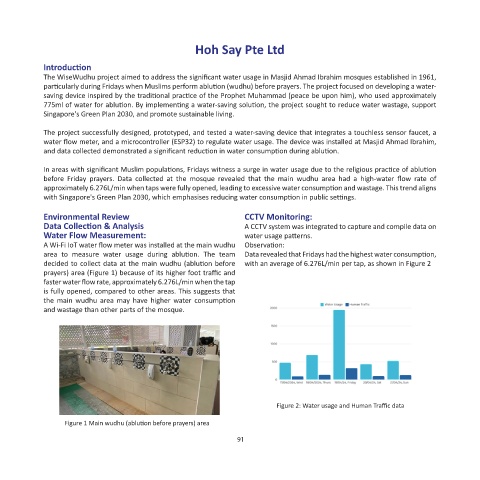
            A Wi-Fi IoT water flow meter was installed at the main wudhu  Observation:
            area  to  measure  water  usage  during  ablution.  The  team  Data revealed that Fridays had the highest water consumption,
            decided to collect data at the main wudhu (ablution before  with an average of 6.276L/min per tap, as shown in Figure 2
            prayers) area (Figure 1) because of its higher foot traffic and
            faster water flow rate, approximately 6.276L/min when the tap
            is fully opened, compared to other areas. This suggests that
            the  main  wudhu  area  may  have  higher  water  consumption
            and wastage than other parts of the mosque.


                                                                         Figure 2: Water usage and Human Traffic data

                  Figure 1 Main wudhu (ablution before prayers) area

                                                               91

