


Page 41 - THE SLOUGHI REVIEW Issue 15
P. 41
T H E   S L O U G H I   R E V I E W                                                                    4 1


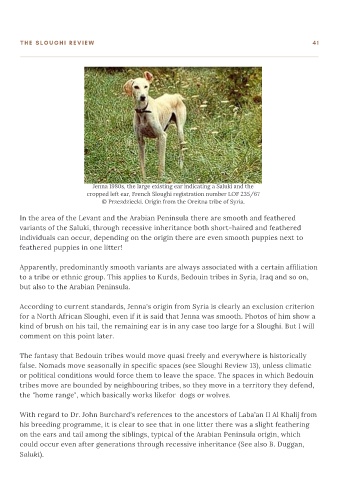
                                  Jenna 1980s, the large existing ear indicating a Saluki and the
                               cropped left ear, French Sloughi registration number LOF 235/67
                                     © Przezdziecki. Origin from the Oreitna tribe of Syria.


        In the area of the Levant and the Arabian Peninsula there are smooth and feathered
        variants of the Saluki, through recessive inheritance both short-haired and feathered
        individuals can occur, depending on the origin there are even smooth puppies next to
        feathered puppies in one litter!


        Apparently, predominantly smooth variants are always associated with a certain affiliation
        to a tribe or ethnic group. This applies to Kurds, Bedouin tribes in Syria, Iraq and so on,
        but also to the Arabian Peninsula.


        According to current standards, Jenna's origin from Syria is clearly an exclusion criterion
        for a North African Sloughi, even if it is said that Jenna was smooth. Photos of him show a

        kind of brush on his tail, the remaining ear is in any case too large for a Sloughi. But I will
        comment on this point later.


        The fantasy that Bedouin tribes would move quasi freely and everywhere is historically
        false. Nomads move seasonally in specific spaces (see Sloughi Review 13), unless climatic
        or political conditions would force them to leave the space. The spaces in which Bedouin
        tribes move are bounded by neighbouring tribes, so they move in a territory they defend,

        the "home range", which basically works likefor  dogs or wolves.


        With regard to Dr. John Burchard's references to the ancestors of Laba'an II Al Khalij from
        his breeding programme, it is clear to see that in one litter there was a slight feathering
        on the ears and tail among the siblings, typical of the Arabian Peninsula origin, which
        could occur even after generations through recessive inheritance (See also B. Duggan,

        Saluki).

