


Page 42 - THE SLOUGHI REVIEW Issue 15
P. 42
T H E   S L O U G H I   R E V I E W                                                                   4 2


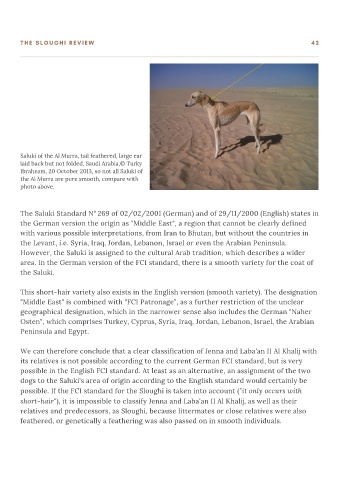
        Saluki of the Al Murra, tail feathered, large ear
        laid back but not folded, Saudi Arabia,© Turky
        Ibraheam, 20 October 2013, so not all Saluki of
        the Al Murra are pure smooth, compare with
        photo above.


                                  o
        The Saluki Standard N 269 of 02/02/2001 (German) and of 29/11/2000 (English) states in
        the German version the origin as "Middle East", a region that cannot be clearly defined
        with various possible interpretations, from Iran to Bhutan, but without the countries in
        the Levant, i.e. Syria, Iraq, Jordan, Lebanon, Israel or even the Arabian Peninsula.

        However, the Saluki is assigned to the cultural Arab tradition, which describes a wider
        area. In the German version of the FCI standard, there is a smooth variety for the coat of
        the Saluki.


        This short-hair variety also exists in the English version (smooth variety). The designation
        "Middle East" is combined with "FCI Patronage", as a further restriction of the unclear
        geographical designation, which in the narrower sense also includes the German "Naher
        Osten", which comprises Turkey, Cyprus, Syria, Iraq, Jordan, Lebanon, Israel, the Arabian

        Peninsula and Egypt.


        We can therefore conclude that a clear classification of Jenna and Laba'an II Al Khalij with
        its relatives is not possible according to the current German FCI standard, but is very
        possible in the English FCI standard. At least as an alternative, an assignment of the two

        dogs to the Saluki's area of origin according to the English standard would certainly be
        possible. If the FCI standard for the Sloughi is taken into account ("it only occurs with
        short-hair"), it is impossible to classify Jenna and Laba'an II Al Khalij, as well as their
        relatives and predecessors, as Sloughi, because littermates or close relatives were also
        feathered, or genetically a feathering was also passed on in smooth individuals.

