


Page 16 - AHATA
P. 16
Wednesday 19 november 2025 locAl
                                      A10


                                                                                                                            Episode CCCXX-330

             Where the Wind Carves Legends: The Watapana and Fofoti of Aruba


              The  narrative  of  Etnia  Nativa—which  means  Native    Yet  over  time,  the  Watapana  has
              Ethnicity—highlights  the  importance  of  recovering     been overshadowed by another tree
              and preserving Aruba’s cultural identity and heritage.    —  the  Fofoti.  While  both  trees  are
              In this episode, we delve into two iconic trees of the    often  confused  due  to  their  similar
              island.                                                   coastal habitats and striking forms, it is
                                                                        the Fofoti that typically steals the spot-
              On  the  sun-drenched,  wind-battered  shores  of  Aru-   light in photographs, especially those
              ba, there are two iconic trees that have captured the     taken at the iconic Eagle Beach.
              hearts of visitors and locals alike: the Watapana and
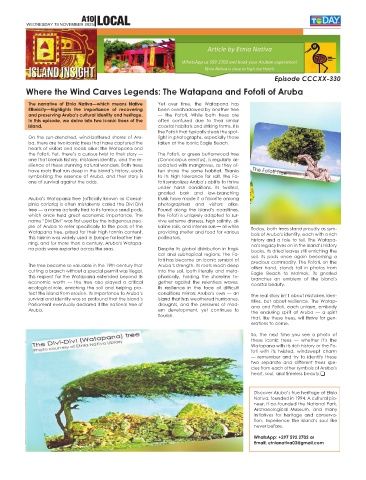
              the Fofoti. Yet, there’s a curious twist to their story —   The Fofoti, or green buttonwood tree
              one that blends history, mistaken identity, and the re-   (Conocarpus erectus), is regularly as-
              silience of these stunning natural wonders. Both trees    sociated with mangroves, as they of-
              have roots that run deep in the island’s history, each    ten  share  the  same  habitat.  Thanks
              symbolizing  the  essence  of  Aruba,  and  their  story  is   to  its  high  tolerance  for  salt,  the  Fo-
              one of survival against the odds.                         foti symbolizes Aruba’s ability to thrive
                                                                        under  harsh  conditions.  Its  twisted,
                                                                        gnarled  bark  and  low-branching
              Aruba’s Watapana tree (officially known as Caesal-        trunk have made it a favorite among
              pinia coriaria) is often mistakenly called the Divi Divi   photographers  and  visitors  alike.
              tree — a name actually tied to its famous seed pods,      Found  along  the  island’s  coastlines,
              which  once  held  great  economic  importance.  The      the Fofoti is uniquely adapted to sur-
              name “Divi Divi” was first used by the indigenous peo-    vive extreme dryness, high salinity, al-
              ple of Aruba to refer specifically to the pods of the     kaline soils, and intense sun — all while   Today, both trees stand proudly as sym-
              Watapana tree, prized for their high tannin content.      providing shelter and food for various    bols of Aruba’s identity, each with a rich
              This tannin was widely used in Europe for leather tan-    pollinators.                              history  and  a  tale  to  tell.  The  Watapa-
              ning, and for more than a century, Aruba’s Watapa-                                                  na’s legacy lives on in the island’s history
              na pods were exported across the seas.                    Despite its global distribution in tropi-  books, its dried leaves still enriching the
                                                                        cal  and  subtropical  regions,  the  Fo-  soil,  its  pods  once  again  becoming  a
                                                                        foti has become an iconic symbol of       precious commodity. The Fofoti, on the
              The tree became so valuable in the 19th century that      Aruba’s strength. Its roots reach deep    other  hand,  stands  tall  in  photos  from
              cutting a branch without a special permit was illegal.    into the soil, both literally and meta-   Eagle  Beach  to  Malmok,  its  gnarled
              This respect for the Watapana extended beyond its         phorically,  holding  the  shoreline  to-  branches  an  emblem  of  the  island’s
              economic  worth  —  the  tree  also  played  a  critical   gether  against  the  relentless  waves.   coastal beauty.
              ecological  role,  enriching  the  soil  and  helping  pro-  Its  resilience  in  the  face  of  difficult
              tect the island from erosion. Its importance to Aruba’s   conditions mirrors Aruba’s own — an       The real story isn’t about mistaken iden-
              survival and identity was so profound that the island’s   island that has weathered hurricanes,     tities,  but  about  resilience.  The  Watap-
              Parliament eventually declared it the national tree of    droughts,  and  the  pressures  of  mod-  ana and Fofoti, each unique, embody
              Aruba.                                                    ern  development,  yet  continues  to     the  enduring  spirit  of  Aruba  —  a  spirit
                                                                        flourish.                                 that, like these trees, will thrive for gen-
                                                                                                                  erations to come.

                                                                                                                  So,  the  next  time  you  see  a  photo  of
                                                                                                                  these  iconic  trees  —  whether  it’s  the
                                                                                                                  Watapana with its rich history or the Fo-
                                                                                                                  foti  with  its  twisted,  windswept  charm
                                                                                                                  —  remember  and  try  to  identify  these
                                                                                                                  two  separate  and  different  trees  spe-
                                                                                                                  cies from each other symbols of Aruba’s
                                                                                                                  heart, soul, and timeless beauty.q


                                                                                                                   Discover Aruba’s true heritage at Etnia
                                                                                                                   Nativa, founded in 1994. A cultural pio-
                                                                                                                   neer, it co-founded the National Park,
                                                                                                                   Archaeological  Museum,  and  many
                                                                                                                   initiatives  for  heritage  and  conserva-
                                                                                                                   tion.  Experience  the  island’s  soul  like
                                                                                                                   never before.

                                                                                                                   WhatsApp: +297 592 2702 or
                                                                                                                   Email: etnianativa03@gmail.com

