


Page 10 - HOH
P. 10
a8    local
                  Monday 3 noveMber 2025
            Food culture in Aruba


            (Oranjestad)  –  Like  many  other  cultures,  an
            important aspect of the Aruban cultural identity
            is  our  connection  to  food  and  food  traditions.
            The local food traditions consist of a melting pot
            of different cultural and religious eating habits
            and dishes.

                      Breakfast, lunch and dinner
            The  routine  of  breakfast,  lunch  and  dinner  on
            the  island  is  one  that  does  not  completely
            follow a European or American routine, despite
            the  major  influences  from  these  parts  of  the
            world on our culture and way of living. When it
            comes to the three important meals of the day,
            most of the Aruban population follows a Latin-
            American influenced routine.
                               Breakfast
            Breakfast  in  Aruba  is  quite  simple:  a  cup  of
            coffee or tea, some bread, and sometimes an
            egg.  Sometimes,  due  to  the  need  of  a  quick
            “to-go”  breakfast,  you  may  also  find  many
            snack  trucks  and  cafes  that  sell  sandwiches,  “meal” can typically consist of something lighter,     Snacks and tasty delights
            pastechis (meat pie), arepas and empanadas  like a sandwich, though it is not uncommon to  Besides meals and dishes that are eaten on the
            early in the morning.                           see leftovers from the main meal reheated and  dinner  table,  Aruba  also  has  a  food  tradition
                                                            eaten  again.  Tea  and  coffee  are  often  also  that  includes  snacks  and  other  tasty  delights
                              Main Meal                     served with the evening snack.                  that  you  may  easily  find  around  the  island.
            The  main  meal  is  typically  eaten  in  most                                                 These include, Saco*, basket, pastechi, kroket,
            households  around  noon  or  in  the  afternoon.             (Religious) Holidays              deditos, Johnny cake and more. These snacks
            This  can  consist  of  meat,  fish,  and  chicken—  Christmas  is  probably  the  biggest  global  are  usually  sold  at  local  snack  trucks  and
            stewed  or  fried—with  funchi  (polenta)  or  rice  holiday, and every culture has its own spin on  cafes,  often  located  on  the  side  of  the  road.
            with stewed vegetables. Often, fried or boiled  what  their  Christmas  cuisine  entails.  In  Aruba,  In the area of Tanki Leendert and Tanki flip, for
            plantain  or  pan  bati  (Aruban  pancake)  is  our  Christmas  cuisine  is  again  largely  based  example, there are many of these trucks parked
            included. Stews are a staple in Aruban cuisine  on  Latin-American  influences,  most  notably  on  the  side  of  the  road  and  often  open  until
            and  can  are  largely  influenced  by  Latin-  form  Venezuela.  Ayacas  and  the  famous  late  at  night—offering  tasty  and  filling  snacks
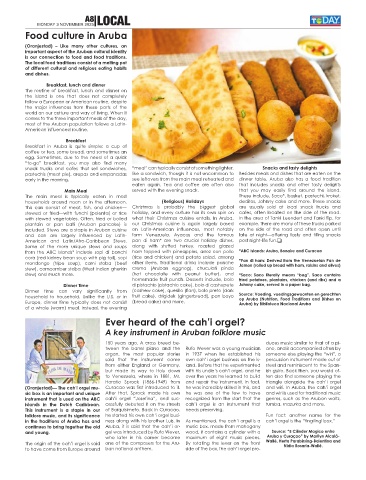
            American  and  Latin/Afro-Caribbean  Stews.  pan  di  ham*  are  two  crucial  holiday  dishes,  post night-life fun.q
            Some  of  the  more  unique  stews  and  soups  along  with  stuffed  turkey,  roasted  glazed
            from  the  ABC  Islands*  include  sopi  di  bonchi  ham topped with pineapples, arroz con pollo   *ABC Islands: Aruba, Bonaire and Curacao
            cora (red kidney bean soup with pig tail), sopi  (rice  and  chicken)  and  potato  salad,  among
            mondongo  (tripe  soup),  carni  stoba  (beef  other  items.  Traditional  drinks  include  ponche   *Pan di ham: Derived from the Venezuelan Pan de
                                                                                                            Jamon (rolled up bread with ham, raisins and olives)
            stew), comcomber stoba (West Indian gherkin  crema  (Aruban  eggnog),  chuculati  pinda
            stew) and much more.                            (hot  chocolate  with  peanut  butter),  and    *Saco:  Saco  literally  means  “bag”.  Saco  contains
                                                            homemade fruit punch. Desserts include, bolo    fried  potatoes,  plantains,  chicken  (and  ribs)  and  a
                              Dinner Time                   di pistachio (pistachio cake), bolo di cashupete   Johnny cake, served in a paper bag.
            Dinner  time  can  vary  significantly  from  (cashew cake), quesillo (flan), bolo preto (dark
            household  to  household.  Unlike  the  U.S.  or  in  fruit  cake),  drigidek  (gingerbread),  pan  boyo   Source: Voeding, voedingsgewoonten en gerechten
                                                                                                            op  Aruba  (Nutrition,  Food  Traditions  and  Dishes  on
            Europe,  dinner  time  typically  does  not  consist  (bread cake) and more.                    Aruba) by Biblioteca Nacional Aruba
            of a whole (warm) meal. Instead, the evening
                                                Ever heard of the cah’i orgel?


                                                A key instrument in Aruban folklore music

                                                150  years ago. A cross breed be-                                       duces music similar to that of a pi-
                                                tween  the  barrel  piano  and  the  Rufo Wever was a young musician  ano, and is accompanied often by
                                                organ,  the  most  popular  stories  in  1937  when  he  established  his  someone else playing the “wiri”, a
                                                said  that  the  instrument  came  own cah’i orgel business on the is-  percussion instrument made out of
                                                from  either  England  or  Germany,  land. Before that he experimented  steel and reminiscent to the Span-
                                                but  made  its  way  to  Italy  down  with his uncle’s cah’i orgel, and he  ish guiro. Back then, you would of-
                                                to  Venezuela,  where  in  1881,  Mr.  over the years he learned to build  ten also find someone playing the
                                                Horatio  Sprock  (1866-1949)  from  and repair the instrument. In fact,  triangle  alongside  the  cah’i  orgel
            (Oranjestad)— The cah’i orgel mu-   Curacao was first introduced to it.  he was incredibly skilled in this, and  and wiri. In Aruba, the cah’i orgel
            sic box is an important and unique  After  that,  Sprock  made  his  own  he  was  one  of  the  few  to  have  and wiri is used for traditional music
            instrument that is used on the ABC  cah’i  orgel  “Josefina”,  and  suc-  recognized from the start that the  genres, such as the Aruban waltz,
            islands  in  the  Dutch  Caribbean.  cessfully debuted it on the streets  cah’i  orgel  is  an  instrument  that  tumba, mazurka and more.
            This  instrument  is  a  staple  in  our  of Barquisimeto. Back in Curacao,  needs preserving.
            folklore music, and its significance  he started his own cah’i orgel busi-                                  Fun  fact:  another  name  for  the
            in the traditions of Aruba has and  ness along with his brother Luis. In  As mentioned, the cah’i orgel is a  cah’i orgel is the “tingilingi box.”
            continues to bring together the old  Aruba,  it  is  said  that  the  cah’i  or-  music box. made from mahogany
            and young.                          gel was introduced by Rufo Wever,  wood, it contains a cylinder with a     Source: “E Cilinder Magico entre
                                                who  later  in  his  career  became  maximum  of  eight  music  pieces.   Aruba y Curaçao” by Marilyn Alcalá-
            The origin of the cah’i orgel is said  one of the composers for the Aru-  By  rotating  the  lever  on  the  front   Wallé, Herta Parabirsing-Balentina and
                                                                                                                                Nidia Rosaria-Wallé.
            to have come from Europe around  ban national anthem.                   side of the box, the cah’i orgel pro-

