


Page 123 - Think 4. Teacher's Book B2
P. 123
Unit 11
           Shoot for the stars              Culture


          Warmer
          Ask students to imagine that they are            Being an astronaut
          going to space for six months. They            30
          can only take one small backpack.
          Ask them what six items they would
          take with them. Allow students time
          for pairs to discuss and put the items   1  Scan the text to find the answers to these questions.
          in order of importance. Hold a class     1  What countries are engaged in space exploration these days?
          vote to decide which they feel are       2  What is the future of the ISS?
          the most and the least important.      2   11.06   Read and listen to the text to check your answers.
                                                                      nal
                                                                      nal
            30                                                        nal      These days, the ISS generally has a crew of three to six people living
                                                  multinati
                                                  multinati
                                                                               on it. Their journey begins on board a Russian Soyuz spaceship,
                                                   A
                                                   A
                                                              enterprise
                                                              enterprise
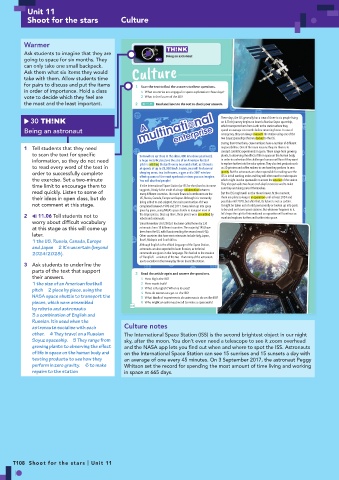
          Being an astronaut                      multinati                    which transports them from Earth to the station where they
                                                                               spend on average six months before returning home. In case of
                                                                               emergency, they can always evacuate the station using one of the
                                                                               two Soyuz spaceships that are docked to the ISS.
          1   Tell students that they need                                     During their time there, crew members have a number of different
                                                                               responsibilities. One of the main reasons they are there is to
            to scan the text for specific         Somewhere up there in the skies, 400 km above your head,   conduct scientific experiments in space. These range from growing
                                                                               plants, to observing the effect of life in space on the human body,
            information, so they do not need      a huge metallic structure the size of an American football   in order to understand the challenges humans will face if they want
                                                                               to explore further into the solar system. They also test products such
            to read every word of the text in     pitch is orbiting the Earth every hour and a half, as it travels   as 3D printers and coffee makers to see how they perform in zero
                                                  at speeds of up to 28,000 km/h. Inside, you will find several
            order to successfully complete        sleeping areas, two bathrooms, a gym and a 360° window   gravity. But the astronauts are also responsible for making sure the
                                                                               ISS is in full working order and they will often need to make repairs
            the exercise. Set a two-minute        offering some of the most spectacular views you can imagine.   which might involve spacewalks to access the exterior of the station.
                                                  You will also find people!
            time limit to encourage them to       It’s the International Space Station (or ISS for short) and as its name   They also put aside two hours each day for exercise and to make
                                                                               sure they are taking care of themselves.
            read quickly. Listen to some of       suggests, it truly is the result of a huge collaboration between   But the ISS might well not be there forever. At the moment,
                                                  many different countries. The main financial contributors are the
            their ideas in open class, but do     US, Russia, Canada, Europe and Japan. Although it is constantly   there are plans to keep it in operation until at least 2024 and
            not comment at this stage.            being added to and adapted, the main construction of it was   possibly until 2028, but after that, its future is not so certain.
                                                                               It might be taken out of orbit permanently or broken up into parts
                                                  completed between 1998 and 2011. It was taken up into space
                                                  piece by piece, using NASA’s space shuttle to transport most of   to be used on future space stations. But whatever happens to it,
          2    11.06 Tell students not to         the larger pieces. Once up there, these pieces were assembled by   let’s hope the spirit of international co-operation will continue as
                                                                               mankind explores further and further into space.
            worry about difficult vocabulary      robots and astronauts.
                                                  Since November 2nd 2000, it has been called home by 230
            at this stage as this will come up    astronauts from 18 different countries. The majority (145) have
            later.                                been from the US, with Russia sending the second most (46).
                                                  Other countries that have sent astronauts include Italy, Japan,
            1 the US, Russia, Canada, Europe      Brazil, Malaysia and South Africa.
            and Japan   2 It’s uncertain (beyond   Although English is the official language of the Space Station,
                                                  astronauts are also expected to learn Russian, as technical
            2024/2028).                           commands are given in that language. This has led to the creation
                                                  of ‘Runglish’ – a mixture of the two – that many of the astronauts
                                                  use to socialise in their everyday life on board the station.
          3  Ask students to underline the
            parts of the text that support       3  Read the article again and answer the questions.
            their answers.                         1  How big is the ISS?
            1 the size of an American football     2  How was it built?
            pitch   2 piece by piece, using the    3  What is Runglish? When is it used?
                                                   4  How do astronauts get to the ISS?
            NASA space shuttle to transport the    5  What kinds of experiments do astronauts do on the ISS?
            pieces, which were assembled           6  Why might an astronaut need to make a spacewalk?
            by robots and astronauts           108
            3 a combination of English and
            Russian. It’s used when the
            astronauts socialise with each   Culture notes
            other.   4 They travel on a Russian   The International Space Station (ISS) is the second brightest object in our night
            Soyuz spaceship.   5 They range from   sky, after the moon. You don’t even need a telescope to see it zoom overhead
            growing plants to observing the effect   and the NASA app lets you find out when and where to spot the ISS. Astronauts
            of life in space on the human body and   on the International Space Station can see 15 sunrises and 15 sunsets a day with
            testing products to see how they   an average of one every 45 minutes. On 3 September 2017, the astronaut Peggy
            perform in zero gravity.   6 to make   Whitson set the record for spending the most amount of time living and working
            repairs to the station           in space at 665 days.


      T108  Shoot for the stars | Unit 11

