


Page 128 - Think 4. Teacher's Book B2
P. 128
Unit 12
          Off the beaten track               Listening; Functions; Pronunciation;                       Values


           6   Check/clarify: pocket.
             Put a copy of the four photos up                                                 OFF THE BEATEN TRACK  UNIT 12
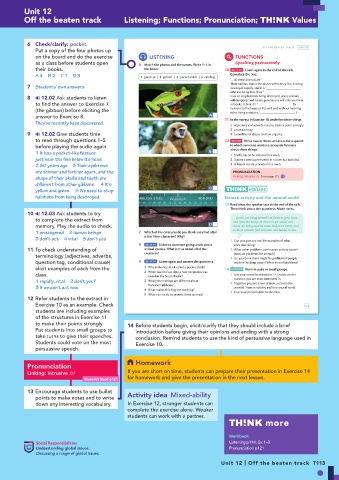
             on the board and do the exercise        LISTENING                      FUNCTIONS
             as a class before students open      6  Match the photos and the names. Write 1–4 in   Speaking persuasively
             their books.                           the boxes.                  10     12.03   Listen again to the end of the talk.
             A 4   B 2   C 1   D 3                 1  giant rat  |  2  gibbon  |  3  pocket shark  |  4  rainfrog  Complete the text.
                                                                                  ‘… all these animals are  1      .
                                                                                  Their habitat, that is the places where they live, is being
           7  Students’ own answers                                               destroyed rapidly, and it is  2
                                                                                  who are doing this. If we  3
           8    12.02 Ask students to listen                                      now, to stop habitats being destroyed, many animals
                                                                                  will disappear and future generations will only see them
             to find the answer to Exercise 7                                     in books. I think it’s  4      for
             (the gibbon) before eliciting the                                    humans to find ways to live well and without harming

                                                                                                          ?
                                                                                            5
                                                                                  other living creatures,
             answer to Exercise 8.                                         A
             They’ve recently been discovered.                                  11 In the extract in Exercise 10, underline these things.
                                                                                  1  adjectives and adverbs used to make a point strongly
                                                                                  2  a question tag
           9    12.02 Give students time                                          3  a conditional clause to show urgency
             to read through questions 1–5                                      12  WRITING   Write two or three sentences for a speech
             before playing the audio again.                                      in which someone wants to persuade listeners
                                                                                  about these things.
             1 It has a pocket-like feature                                B      1  Traffic has to be reduced in a town.
             just near the fins below its head.                                   2  Having a new supermarket in a town is a bad idea.
             2 80 years ago   3 Their eyebrows                                    3  A leisure centre is needed in a town.
             are thinner and farther apart, and the                                PRONUNCIATION
             shape of their skulls and teeth are                                   Linking: intrusive /r/  Go to page 121.
             different from other gibbons.   4 It’s
             yellow and green.   5 We need to stop                         C
             habitats from being destroyed.                                     Human activity and the natural world
                                                                                13 Read what the speaker says at the end of the talk.
                                                                                  Then think about the questions. Make notes.
           10   12.03 Ask students to try
             to complete the extract from                                          … forests are being turned into fields to grow food,
                                                                                   and trees are being cut down to get wood, and
             memory. Play the audio to check.                              D       rivers are being used by more and more boats, and
             1 endangered   2 human beings        7  Which of the creatures do you think is named after   so these animals find it harder and harder to live.
             3 don’t act   4 vital   5 don’t you    a Star Wars character? Why?
                                                                                  1  Can you give any real-life examples of what
                                                  8      12.02   Listen to someone giving a talk about   she’s describing?
           11 To check understanding of             animal species. What is true about all of the   2  What other problems can human activity cause?
                                                                                   (not just problems for animals)
             terminology (adjectives, adverbs,      creatures?                    3  Do you think there might be problems if people
             question tag, conditional clause)    9      12.02   Listen again and answer the questions.  explore the deep ocean? What kind of problems?
             elicit examples of each from the       1  Why is the tiny shark called a pocket shark?  14  SPEAKING   Work in pairs or small groups.
                                                                                  SPEAKING
             class.                                 2  When was the last time a new rat species was   1  Use your notes from Exercise 13. Decide on the
                                                     found in the South Pacific?
                                                                                   question you are most interested in.
             1 rapidly, vital   2 don’t you?        3  Which three things are different about   2  Together, prepare a two-minute presentation
               3 If we don’t act now                 Skywalker gibbons?            entitled ‘Human activity and the natural world’.
                                                    4  What makes this frog eye-catching?  3  Give your presentation to the class.
                                                    5  What can we do to protect these animals?
           12 Refer students to the extract in
             Exercise 10 as an example. Check                                                               113
             students are including examples
             of the structures in Exercise 11
             to make their points strongly.   14 Before students begin, elicit/clarify that they should include a brief
             Put students into small groups to   introduction before giving their opinions and ending with a strong
             take turns to give their speeches.   conclusion. Remind students to use the kind of persuasive language used in
             Students could vote on the most     Exercise 10.
             persuasive speech.

                                                 Homework
           Pronunciation
           Linking: intrusive /r/             If you are short on time, students can prepare their presentation in Exercise 14
                               Student’s Book p121  for homework and give the presentation in the next lesson.
           13 Encourage students to use bullet
             points to make notes and to write   Activity idea  Mixed-ability
             down any interesting vocabulary.  In Exercise 12, stronger students can
                                              complete the exercise alone. Weaker
                                              students can work with a partner.
                                                                                              more

                                                                                  Workbook
              Social Responsibilities                                             Listening p114, Ex.1–3
              Understanding global issues                                         Pronunciation p121
              Discussing a range of global issues.
                                                                               Unit 12 | Off the beaten track T113

