


Page 129 - Think 4. Teacher's Book B2
P. 129
Unit 12
           Off the beaten track             Reading


          Warmer
          Ask: How do you travel to … (city
          near the school)? Elicit answers in
          open class. Ask: How could you           lmost every country on our planet has been explored and mapped and all of these have roads,
          travel if there were no roads or       Arailways and lines of communication. So it can be hard for us to imagine the people who went there
                                                 without all the infrastructure that we now take for granted.
          railways? How long would it take?      This series celebrates the men and women who opened the world up and risked their lives to protect the
                                                 people and environments they discovered along the way. This week, we profile a man not well-known
          Ask students to discuss with a         outside his own country and continent – Cândido Rondon.
          partner before eliciting some of their
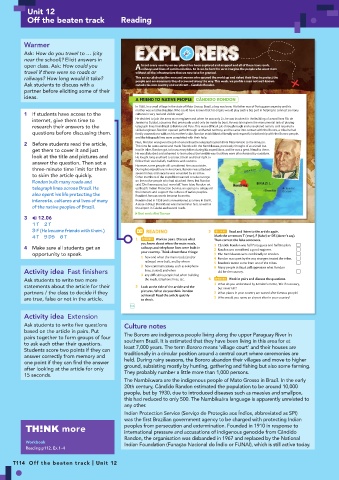
          ideas.                                 A FRIEND TO NATIVE PEOPLE  CÂNDIDO RONDON
                                                 In 1865, in a small village in the state of Mato Grosso, Brazil, a boy was born. His father was of Portuguese ancestry and his
                                                 mother was a native Brazilian. Who could have known that his origins would play such a big part in helping to connect so many
          1   If students have access to the     cultures in very real and visible ways?
            internet, give them time to          He decided to join the army as an engineer and when he was only 25, he was involved in the building of a road from Rio de
                                                 Janeiro to Cuiabá, a journey that previously could only be made by boat. He was later given the monumental task of placing
            research their answers to the        telegraph lines from Brazil to Bolivia and Peru. This was a difficult job through rough and unexplored terrain, so it required a
            questions before discussing them.    skilled engineer. Rondon opened paths through uncharted territory, and he came into contact with the Bororo, a tribe he had
                                                 family connections with on his mother’s side. Rondon established a friendly and respectful relationship with the Bororo people,
                                                 and the telegraph lines were completed with their help.
          2  Before students read the article,   Next, Rondon was given the job of extending the telegraph system from Mato Grosso to the Amazon.
                                                 This time he came across and made friends with the Nambikwara, previously thought of as a timid but
            get them to cover it and just        hostile tribe. Rondon got to know many tribes during his expeditions, and he was a great friend to them.
            look at the title and pictures and   He was disturbed and ashamed to learn about the terrible way that they were often treated by outsiders.
                                                 He fought long and hard to protect them and their right to
            answer the question. Then set a      follow their own beliefs, traditions and customs.
                                                 However, some people still considered him an outsider.
            three-minute time limit for them     During his expeditions in Amazonia, Rondon was attacked
            to skim the article quickly.         several times, and once he was wounded by an arrow.
                                                 Other members of the expedition wanted to take revenge
            Rondon built many roads and          on the native people who had attacked them, but Rondon
                                                 said, ‘Die if necessary, but never kill.’ Years later, Rondon set
            telegraph lines across Brazil. He    up Brazil’s Indian Protection Service, an agency to safeguard
            also spent his life protecting the   the interests and support the cultures of native peoples.
                                                 Rondon’s famous words became its motto.
            interests, cultures and lives of many   Rondon died in 1958 and is remembered as a hero in Brazil.
            of the native peoples of Brazil.     A state in Brazil (Rondônia) was named after him, as well as
                                                 the airport in Cuiabá and several roads.
                                                  Next week: Abel Tasman
          3    12.06
            1 T   2 T
            3 F (He became friends with them.)      READING               3   12.06   Read and listen to the article again.
            4 T   5 DS   6 T                     1   SPEAKING Work in pairs. Discuss what   Mark the sentences T (true), F (false) or DS (doesn’t say).
                                                   SPEAKING
                                                                            Then correct the false sentences.
                                                   you know about when the main roads,   1  Cândido Rondon was half Portuguese and half Brazilian.
          4  Make sure all students get an         railways and telephone lines were built in   2  Rondon was considered a good engineer.
            opportunity to speak.                  your country. Think about these things:  3  The Nambikwara were not friendly to Rondon.
                                                   1  how and when the main roads (and/or   4  Rondon was upset by the way strangers treated the tribes.
                                                    railways) were built, and by whom  5  Rondon’s motto came from one of the tribes.
                                                   2  how communications, such as telephone   6  Many people in Brazil still appreciate what Rondon
          Activity idea  Fast finishers             lines, started, and when  did for the country.
                                                   3  any difficulties people had when building
          Ask students to write two more            the roads, telephone lines, etc.  4   SPEAKING Work in pairs and discuss the questions.
                                                                             SPEAKING
          statements about the article for their   2  Look at the title of the article and the   1  What do you understand by Rondon’s motto, ‘Die if necessary,
                                                                              but never kill.’?
          partners / the class to decide if they   pictures. What do you think Rondon   2  What places in your country are named after famous people?
                                                   achieved? Read the article quickly
          are true, false or not in the article.   to check.                3  Who would you name an airport after in your country?
                                               114
          Activity idea  Extension
          Ask students to write five questions   Culture notes
          based on the article in pairs. Put
          pairs together to form groups of four   The Bororo are indigenous people living along the upper Paraguay River in
          to ask each other their questions.   southern Brazil. It is estimated that they have been living in this area for at
          Students score two points if they can   least 7,000 years. The term Bororo means ‘village court’ and their houses are
          answer correctly from memory and   traditionally in a circular position around a central court where ceremonies are
          one point if they can find the answer   held. During rainy seasons, the Bororo abandon their villages and move to higher
          after looking at the article for only   ground, subsisting mostly by hunting, gathering and fishing but also some farming.
          15 seconds.                        They probably number a little more than 1,000 persons.
                                             The Nambikwara are the indigenous people of Mato Grosso in Brazil. In the early
                                             20th century, Cândido Randon estimated the population to be around 10,000
                                             people, but by 1930, due to introduced diseases such as measles and smallpox,
                                             this had reduced to only 500. The Nambikuára language is apparently unrelated to
                                             any other.
                                             Indian Protection Service (Serviço de Proteção aos Índios, abbreviated as SPI)
                                             was the first Brazilian government agency to be charged with protecting Indian
                       more                  peoples from persecution and extermination. Founded in 1910 in response to
                                             international pressure and accusations of indigenous genocide from Cândido
                                             Randon, the organisation was disbanded in 1967 and replaced by the National
          Workbook                           Indian Foundation (Funaçāo Nacional do Índio or FUNAI), which is still active today.
          Reading p112, Ex.1–4

      T114  Off the beaten track | Unit 12

