


Page 36 - Think 4. Teacher's Book B2
P. 36
Unit 2
          On the road                        Reading; Train to


           Culture notes                                                                          ON THE ROAd  UNIT 2
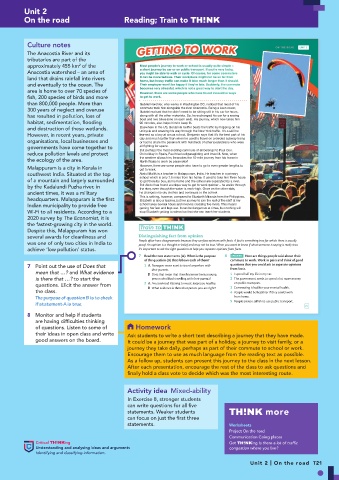
           The Anacostia River and its           GETTING TO WORK
           tributaries are part of the
           approximately 455 km  of the           Most people’s journey to work or school is usually quite simple –
                             2
           Anacostia watershed – an area of       a short journey by car or on public transport. If you’re very lucky,
                                                  you might be able to walk or cycle. Of course, for some commuters
           land that drains rainfall into rivers   it can be more tedious. Their workplace might not be so far from
                                                  home, but heavy traffic can make it take much longer than it should.
           and eventually to the ocean. The       Their employer won’t be happy if they’re late. Suddenly, the commute
           area is home to over 70 species of     becomes very stressful, which is not a great way to start the day.
                                                  However, there are some people who have found innovative ways
           fish, 200 species of birds and more    to get to work.
           than 800,000 people. More than         Gabriel Hor chler , who works in W ashington DC, noticed that most of his
                                                  Gabriel Horchler, who works in Washington DC, noticed that most of his
                                                  commute took him alongside the river Anacostia. Being a keen rower,
           300 years of neglect and overuse       commute took him alongside the river Anacostia. Being a keen rower,
                                                  Gabriel realised that he didn’t need to be sitting still in his car for hours,
                                                  Gabriel realised that he didn’t need to be sitting still in his car for hours,
           has resulted in pollution, loss of     along with all the other motorists. So, he exchanged his car for a rowing
                                                  along with all the other motorists. So, he exchanged his car for a rowing
                                                  boat and two bikes (one on each end). His journey, which now takes him
           habitat, sedimentation, flooding       boat and two bikes (one on each end). His journey, which now takes him
                                                  90 minutes, also helps him to keep fit.
           and destruction of these wetlands.     Elsewhere in the US, Benjamin Keiffer beats the traffic by hopping on his
                                                  unicycle and weaving his way through the New York traffic. It’s a skill he
           However, in recent years, private      learned as a boy at circus school. Benjamin says that it’s the best part of his
           organisations, local businesses and    day and much better than when he used to travel on crowded subway trains
                                                  or had to share the pavement with hundreds of other pedestrians who were
           governments have come together to      all fighting for space.
                                                  But perhaps the most exciting commute of all belongs to Paul Cox.
           reduce pollution levels and protect    On holiday in Spain, Paul tried out paragliding and loved it. Now, when
           the ecology of the area.               the weather allows him, he makes the 10-mile journey from his home in
                                                  North Wales to work by paramotor!
           Malappuram is a city in Kerala in      However, there are some people who have to go to even greater lengths to
                                                  get to work.
           southwest India. Situated at the top   Abdul Mallik is a teacher in Malappuram, India. He teaches in a primary
           of a mountain and largely surrounded   school which is only 7.5 miles from his home. It used to take him three hours
                                                  to get there by bus, as his home and the school are separated by a river.
           by the Kadalundi Puzha river, in       But Abdul has found a unique way to get to work quicker – he walks through
                                                  the river, even though the water is neck-high. Once on the other side,
           ancient times, it was a military       he changes into dry clothes and continues to the school.
           headquarters. Malappuram is the first   This is nothing, however, compared to Elizabeth Miranda from the Philippines.
                                                  Elizabeth is also a teacher, but her journey to join the rest of the staff at her
           Indian municipality to provide free    school takes several hours and involves crossing five rivers. This means
                                                  getting her feet and legs wet. It can be dangerous at times, but nothing will
           Wi-Fi to all residents. According to a   stop Elizabeth getting to school so that she can teach her students.
           2020 survey by The Economist, it is
           the fastest-growing city in the world.
           Despite this, Malappuram has won
           several awards for cleanliness and     Distinguishing fact from opinion
           was one of only two cities in India to   People often have disagreements because they confuse opinions with facts. A fact is something true for which there is usually
                                                  proof. An opinion is a thought or belief and may not be true. When you want to know if what someone is saying is really true,
           achieve ‘low pollution’ status.        it’s important to ask the right questions to help you separate opinions from facts.
                                                  7  Read the two statements (A). What is the purpose   8   SPEAKING
                                                                                  SPEAKING   Here are things people said about their
                                                    of the question (B) that follows each of them?  commute to work. Work in pairs and think of good
           7   Point out the use of Does that       1  A  Teenagers never want to travel anywhere with   questions that you could ask to separate opinions
                                                                                  from facts.
                                                      their parents.
             mean that …? and What evidence           B  Does that mean that there has never been a young   1  I spend half my life in my car.
             is there that …? to start the            person who liked travelling with their parents?  2  The government needs to spend a lot more money
                                                                                   on public transport.
                                                      I
             questions. Elicit the answer from      2  A  ’m convinced listening to music keeps you healthy.  3  Commuting is bad for your mental health.
                                                      B  What evidence is there that proves you are right?
             the class.                                                           4  People would be healthier if they could work
             The purpose of question B is to check                                 from home.
             if statement A is true.                                              5  People are too selfish to use public transport.  21
           8  Monitor and help if students
             are having difficulties thinking
             of questions. Listen to some of     Homework
             their ideas in open class and write   Ask students to write a short text describing a journey that they have made.
             good answers on the board.       It could be a journey that was part of a holiday, a journey to visit family, or a
                                              journey they take daily, perhaps as part of their commute to school or work.
                                              Encourage them to use as much language from the reading text as possible.
                                              As a follow up, students can present this journey to the class in the next lesson.
                                              After each presentation, encourage the rest of the class to ask questions and
                                              finally hold a class vote to decide which was the most interesting route.
                                              Activity idea  Mixed-ability
                                              In Exercise 8, stronger students
                                              can write questions for all five
                                              statements. Weaker students                     more
                                              can focus on just the first three
                                              statements.                         Worksheets
                                                                                  Project On the road
                                                                                  Communication Going places
              Critical   ing                                                      Get     ing Is there a lot of traffic
              Understanding and analysing ideas and arguments                     congestion where you live?
              Identifying and classifying information.
                                                                                         Unit 2 | On the road T21

