


Page 41 - Think 4. Teacher's Book B2
P. 41
Unit 2
           On the road                      Culture


          Warmer
          Call out either the verb or the                  Nomadic people and animals   NOMADIC
          particle from the phrasal verbs in             06
          Exercise 4 on page 24, and elicit the                                            PEOPLE
          whole phrasal verb. For example,
          you say bring or about and students
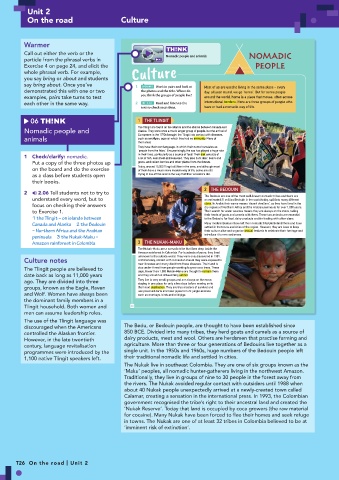
          say bring about. Once you’ve           1   SPEAKING   Work in pairs and look at   Most of us are used to living in the same place – every
                                                   SPEAKING
          demonstrated this with one or two        the photos and the title. Where do   day, all year round, we go ‘home’. But for some people
          examples, pairs take turns to test       you think the groups of people live?  around the world, home is a place that moves, often across
          each other in the same way.            2   2.06   Read and listen to the   international borders. Here are three groups of people who
                                                   text to check your ideas.  have or had a nomadic way of life.

            06                                     1  THE TLINGIT
                                                  The Tlingit are found on the islands and the shores between Canada and
          Nomadic people and                      Alaska. They were once a much larger group of people, but the arrival of
                                                  Europeans in the 1770s brought the Tlingit into contact with diseases,
          animals                                 such as smallpox, against which they had no immunity. Many of
                                                  them died.
                                                  They have their own language, in which their name translates as
                                                  ‘people from the tides’. Unsurprisingly, the sea has played a huge role
          1   Check/clarify: nomadic.             in their lives, particularly as a source of food. Their diet consists of
                                                  a lot of fish, seal meat and seaweed. They also hunt deer, bears and
            Put a copy of the three photos up     goats, and collect berries and other plants from the forests.
            on the board and do the exercise      Today, around 15,000 Tlingit still live in the area, and although most
                                                  of them have a much more modern way of life, some are still
            as a class before students open       trying to live off the land in the way that their ancestors did.
            their books.
                                                                          2  THE BEDOUIN
          2    2.06 Tell students not to try to                          The Bedouin are one of the most well-known nomadic tribes and there are
            understand every word, but to                                an estimated 21 million Bedouin in the world today, split into many different
            focus on checking their answers                              clans. In Arabic their name means ‘desert dwellers’, as they have lived in the
                                                                         dry regions of Northern Africa and the Arabian peninsula for over 1,000 years.
            to Exercise 1.                                               Their search for water sources means they are always on the move, taking
                                                                         their herds of goats and camels with them. These two animals are essential
            1 the Tlingit – on islands between                           to the Bedouin, for food, dairy products and for trading with other clans.
            Canada and Alaska   2 the Bedouin                            Many modern Bedouin have left their nomadic lifestyle behind them and have
                                                                         settled in the towns and cities of the region. However, they are keen to keep
            – Northern Africa and the Arabian                            their culture alive and organise annual festivals to celebrate their heritage and
            peninsula   3 the Nukak-Maku –                               introduce it to new audiences.
            Amazon rainforest in Colombia         3  THE NUKAK-MAKU
                                                  The Nukak-Maku are a nomadic tribe that lives deep inside the
                                                  Amazon rainforest in Colombia. For hundreds of years, they lived
                                                  unknown to the outside world. They were only discovered in 1981.
          Culture notes                           Unfortunately, contact with civilisation meant they were exposed to
                                                  new illnesses and many died from these diseases. Their land is
          The Tlingit people are believed to      also under threat from people wanting to grow coca trees. These
                                                  days, fewer than 1,000 Nukak-Maku are thought to remain there
          date back as long as 11,000 years       and they are at risk of becoming extinct.
          ago. They are divided into three        They live in very small groups and are always on the move,
                                                  staying in one place for only a few days before moving on to
          groups, known as the Eagle, Raven       their next destination. They are true masters of survival and
          and Wolf. Women have always been        use poisoned darts and blow pipes to hunt jungle animals
                                                  such as monkeys, birds and wild pigs.
          the dominant family members in a
          Tlingit household. Both women and    26
          men can assume leadership roles.
          The use of the Tlingit language was
          discouraged when the Americans     The Bedu, or Bedouin people, are thought to have been established since
          controlled the Alaskan frontier.   850 BCE. Divided into many tribes, they herd goats and camels as a source of
          However, in the late twentieth     dairy products, meat and wool. Others are herdsmen that practise farming and
          century, language revitalisation   agriculture. More than three or four generations of Bedouins live together as a
          programmes were introduced by the   single unit. In the 1950s and 1960s, huge numbers of the Bedouin people left
          1,100 native Tlingit speakers left.  their traditional nomadic life and settled in cities.
                                             The Nukak live in southeast Colombia. They are one of six groups known as the
                                             ‘Maku’ peoples, all nomadic hunter-gatherers living in the northwest Amazon.
                                             Traditionally, they live in groups of nine to 30 people in the forest away from
                                             the rivers. The Nukak avoided regular contact with outsiders until 1988 when
                                             about 40 Nukak people unexpectedly arrived at a newly-created town called
                                             Calamar, creating a sensation in the international press. In 1993, the Colombian
                                             government recognised the tribe’s right to their ancestral land and created the
                                             ‘Nukak Reserve’. Today that land is occupied by coca growers (the raw material
                                             for cocaine). Many Nukak have been forced to flee their homes and seek refuge
                                             in towns. The Nukak are one of at least 32 tribes in Colombia believed to be at
                                             ‘imminent risk of extinction’.


       T26  On the road | Unit 2

