


Page 291 - maintg
P. 291
Haines was originally settled by the Tlingit Native
      tribes of the Chilkat and Chilkoot clans. They chose
      this area because of its mild climate and the abundance
      of fish and game. Near the end of the 18th century
      when the first Caucasians came, the Chilkats were well
      established as a powerful trading tribe. They became
      quite rich by trading rendered fish oil for furs and skins
      produced in the interior.
        As an Anglo settlement, Haines was established in
      1880 as a Presbyterian mission. The mission included
      a school, church, and meeting hall and was named after
      Mrs. F. E. Haines, the secretary of the Presbyterian
      Home Mission. Commerce, farming, fishing, and
      government followed the establishment of the mission
      and contributed to the area’s growth.
        Haines served as an important supply base for the
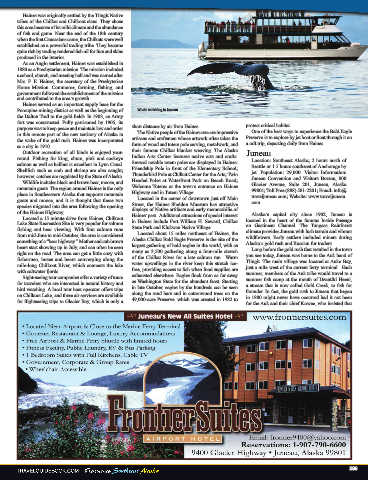
      Porcupine mining district as well as the beginning of   Whale watching in Juneau
      the Dalton Trail to the gold fields. In 1903, an Army
      fort was constructed. Fully garrisoned by 1905, its
      purpose was to keep peace and maintain law and order   short distance by air from Haines.  protect critical habitat.
                                                                                  One of the best ways to experience the Bald Eagle
      in this remote part of the new territory of Alaska in   The Native people of the Haines area are impressive
      the wake of the gold rush. Haines was incorporated   artisans and craftsmen whose artwork often takes the   Preserve is to explore by jet boat or float through it on
                                                                                a raft trip, departing daily from Haines.
      as a city in 1910.                   form of wood and totem pole carving, metalwork, and
        Outdoor recreation of all kinds is enjoyed year-  their famous Chilkat blanket weaving. The Alaska   Juneau
      round. Fishing for king, chum, pink and sockeye   Indian Arts Center features native arts and crafts.   Location: Southeast Alaska; 2 hours north of
      salmon as well as halibut is excellent in Lynn Canal.   Several notable totem poles are displayed in Haines:   Seattle or 1.5 hours southeast of Anchorage by
      Shellfish such as crab and shrimp are also caught;   Friendship Pole in front of the Elementary School;   jet. Population: 29,000.  Visitor Information:
      however, catches are regulated by the State of Alaska.  Thunderbird Pole at Chilkat Center for the Arts; Twin   Juneau Convention and  Visitors Bureau, 800
        Wildlife includes black and brown bear, moose, and   Headed Poles at Waterfront Park on Beach Road;   Glacier  Avenue, Suite 201, Juneau,  Alaska
      mountain goats. The region around Haines is the only   Welcome Totems at the town’s entrance on Haines   99801; Toll Free (888) 581-2201; Email: info@
      place in Southeastern Alaska that supports mountain   Highway and in Totem Village.  traveljuneau.com; Website: www.traveljuneau.
      goats and moose, and it is thought that these two   Located in the center of downtown just off Main   com.
      species migrated into the area following the opening   Street, the Haines Sheldon Museum has attractive
      of the Haines Highway.               displays of Native artifacts and early memorabilia of   Alaska’s capital city since 1902, Juneau is
        Located a 15 minute drive from Haines, Chilkoot   Haines’ past.  Additional attractions of special interest   located in the heart of the famous Inside Passage
      Lake State Recreation Site is very popular for salmon   in Haines include Fort William H. Seward, Chilkat   on Gastineau Channel.  The  Tongass Rainforest
      fishing and bear viewing. With four salmon runs   State Park and Klukwan Native Village.   climate provides Juneau with lush terrain and vibrant
      from mid-June to mid-October, the area is considered   Located about 15 miles northeast of Haines, the   wildflowers.  Early  settlers  included  miners  during
      something of a “bear highway.” Mother and cub brown   Alaska Chilkat Bald Eagle Preserve is the site of the   Alaska’s gold rush and Russian fur traders.
      bears start showing up in July, and can often be seen   largest gathering of bald eagles in the world, with as   Long before the gold rush that resulted in the town
      right on the road. The area can get a little cozy with   many as 3,500 gathering along a four-mile stretch   you see today, Juneau was home to the Auk band of
      fishermen, buses and bears converging along the   of the Chilkat River for a late salmon run.  Warm   Tlingit. The main village was located at Auke Bay,
      mile-long Chilkoot River, which connects the lake   water upwellings in the river keep this stretch ice-  just a mile west of the current ferry terminal.  Each
      with saltwater fjords.               free, providing access to fish when food supplies are   summer, members of the Auk tribe would travel to a
        Sight-seeing tour companies offer a variety of tours   exhausted elsewhere. Eagles flock from as far away   summer fish camp at the mouth of Dzantiki Heeni,
      for travelers who are interested in natural history and   as Washington State for the abundant feast. Starting   a stream that is now called Gold Creek, to fish for
      bird watching. A local tour boat operator offers trips   in late October, eagles by the hundreds can be seen   flounder. In fact, the gold rush to Juneau that began
      on Chilkoot Lake, and three air services are available   along the sand bars and in cottonwood trees on the   in 1880 might never have occurred had it not been
      for flightseeing trips to Glacier Bay, which is only a   49,000-acre Preserve. which was created in 1982 to   for the Auk and their chief Kowee, who insisted that


                                                                                                                  289

