


Page 53 - 2025 INCOSE_01-23-2020
P. 53
of soft skills, particularly those needed to inte-  the curriculum, instructional methods, and the
                             grate across a multi-disciplinary environment   instructor competencies. This field will be continu-
                             that spans regions, organizations, and industries.   ally enriched by extensive theoretical elements
                                                                             from physics/engineering, sociology/anthropol-
                             For continuing relevance, systems engineering   ogy and economics/political science. Educational
                             education and training will stay abreast of     and training programs will also become more per-
                             the advancing processes, methods and tools      vasive to support the broadening applications of
                             while providing grounding in the theoretical    systems engineering, and the increased demands
                             foundations. This imposes requirements on       on the number of systems engineers.


                             Lifelong Learning


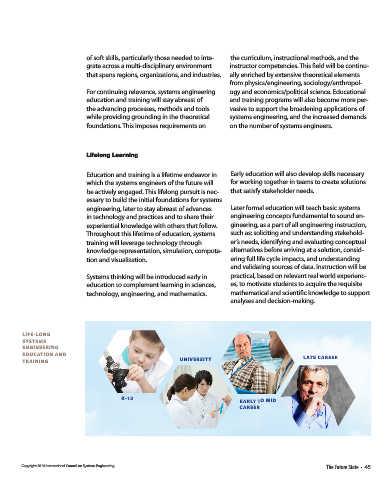
                             Education and training is a lifetime endeavor in   Early education will also develop skills necessary
                             which the systems engineers of the future will    for working together in teams to create solutions
                             be actively engaged. This lifelong pursuit is nec-  that satisfy stakeholder needs.
                             essary to build the initial foundations for systems
                             engineering, later to stay abreast of advances   Later formal education will teach basic systems
                             in technology and practices and to share their   engineering concepts fundamental to sound en-
                             experiential knowledge with others that follow.   gineering, as a part of all engineering instruction,
                             Throughout this lifetime of education, systems   such as: soliciting and understanding stakehold-
                             training will leverage technology through       er’s needs, identifying and evaluating conceptual
                             knowledge representation, simulation, computa-  alternatives before arriving at a solution, consid-
                             tion and visualization.                         ering full life cycle impacts, and understanding
                                                                             and validating sources of data. Instruction will be
                             Systems thinking will be introduced early in    practical, based on relevant real world experienc-
                             education to complement learning in sciences,   es, to motivate students to acquire the requisite
                             technology, engineering, and mathematics.       mathematical and scientific knowledge to support
                                                                             analyses and decision-making.


        LIFE-LONG
        SYSTEMS
        ENGINEERING
        EDUCATION AND
        TRAINING                                            UNIVERSITY                               LATE CAREER


                                         K-12                                   EARLY TO MID
                                                                                CAREER


        Copyright 2014 International Council on Systems Engineering                                          The Future State  •  45

